The above picture may not look like much, but it could be a huge deal. The photograph, taken by the Opportunity Rover at Mars’ Cape York site, shows iron spherules that researchers commonly refer to as “blueberries.” Similar formations are found here on Earth. The catch is that, here, they are formed with help from microbial organisms, suggesting that these unassuming iron marbles could be a telltale sign of ancient life on the red planet.
Typically just a couple millimeters across, iron blueberries are a pretty standard part of the Martian landscape, found on the ground of the Cape York site where Opportunity is doing its research or embedded in rock. They bear a distinct resemblance to the “Moqui marbles” found around the American southwest. Ranging in size rom BB pellets to cannonballs, Moqui marbles are not unlike geological M&Ms, consisting of a thin iron shell filled will sand.
A study published earlier this month in the journal Geology found strong evidence that the marbles are not a purely geological oddity, but were formed with an assist from microbes. That finding is a strong suggestion that the Moqui marbles’ Martian cousins may be a good candidate for indicators that Mars once sustained microbial life.
The blueberries recently discovered by Opportunity — which is still chugging along after eight years, and with less fanfare than the rover-of-the-minute Curiosity — are in an area not known for its iron content, but for the possibility that it may have clay deposits, suggesting it may once have been a site for flowing water. Between those two findings, Opportunity could certainly be in worse places to look for ancient martian microbes. The search for those signs is still akin to looking for a needle in a haystack, of course, but the haystack may have just gotten a lot smaller.
(via PhysOrg, University of Nebraska-Lincoln, image courtesy of NASA)
Saturday, September 15, 2012
The blueberries recently discovered by Opportunity — which is still chugging along after eight years, and with less fanfare than the rover-of-the-minute Curiosity
Monday, August 6, 2012
Today, the wheels of Curiosity have begun to blaze the trail for human footprints on Mars.
PASADENA, Calif. -- NASA's most advanced Mars rover Curiosity has landed on the Red Planet. The one-ton rover, hanging by ropes from a rocket backpack, touched down onto Mars Sunday to end a 36-week flight and begin a two-year investigation.
The Mars Science Laboratory (MSL) spacecraft that carried Curiosity succeeded in every step of the most complex landing ever attempted on Mars, including the final severing of the bridle cords and flyaway maneuver of the rocket backpack.
"Today, the wheels of Curiosity have begun to blaze the trail for human footprints on Mars. Curiosity, the most sophisticated rover ever built, is now on the surface of the Red Planet, where it will seek to answer age-old questions about whether life ever existed on Mars -- or if the planet can sustain life in the future," said NASA Administrator Charles Bolden.
"This is an amazing achievement, made possible by a team of scientists and engineers from around the world and led by the extraordinary men and women of NASA and our Jet Propulsion Laboratory. President Obama has laid out a bold vision for sending humans to Mars in the mid-2030's, and today's landing marks a significant step toward achieving this goal."
Curiosity landed at 10:32 p.m. Aug. 5, PDT, (1:32 a.m. EDT Aug. 6) near the foot of a mountain three miles tall and 96 miles in diameter inside Gale Crater. During a nearly two-year prime mission, the rover will investigate whether the region ever offered conditions favorable for microbial life.
"The Seven Minutes of Terror has turned into the Seven Minutes of Triumph," said NASA Associate Administrator for Science John Grunsfeld. "My immense joy in the success of this mission is matched only by overwhelming pride I feel for the women and men of the mission's team."
Curiosity returned its first view of Mars, a wide-angle scene of rocky ground near the front of the rover. More images are anticipated in the next several days as the mission blends observations of the landing site with activities to configure the rover for work and check the performance of its instruments and mechanisms.
"Our Curiosity is talking to us from the surface of Mars," said MSL Project Manager Peter Theisinger of NASA's Jet Propulsion Laboratory in Pasadena, Calif. "The landing takes us past the most hazardous moments for this project, and begins a new and exciting mission to pursue its scientific objectives."
Confirmation of Curiosity's successful landing came in communications relayed by NASA's Mars Odyssey orbiter and received by the Canberra, Australia, antenna station of NASA's Deep Space Network.
Curiosity carries 10 science instruments with a total mass 15 times as large as the science payloads on the Mars rovers Spirit and Opportunity. Some of the tools are the first of their kind on Mars, such as a laser-firing instrument for checking elemental composition of rocks from a distance. The rover will use a drill and scoop at the end of its robotic arm to gather soil and powdered samples of rock interiors, then sieve and parcel out these samples into analytical laboratory instruments inside the rover.
To handle this science toolkit, Curiosity is twice as long and five times as heavy as Spirit or Opportunity. The Gale Crater landing site places the rover within driving distance of layers of the crater's interior mountain. Observations from orbit have identified clay and sulfate minerals in the lower layers, indicating a wet history.
The mission is managed by JPL for NASA's Science Mission Directorate in Washington. The rover was designed, developed and assembled at JPL. JPL is a division of the California Institute of Technology in Pasadena.
For more information on the mission, visit: http://www.nasa.gov/marshttp://www.nasa.gov/mars and http://marsprogram.jpl.nasa.gov/mslhttp://marsprogram.jpl.nasa.gov/msl .
Follow the mission on Facebook and Twitter at: http://www.facebook.com/marscuriosity And http://www.twitter.com/marscuriosity .
Guy Webster / D.C. Agle 818-354-6278 / 818-393-9011
Jet Propulsion Laboratory, Pasadena, Calif.
guy.webster@jpl.nasa.gov / agle@jpl.nasa.gov
Dwayne Brown 202-358-1726
NASA Headquarters, Washington
dwayne.c.brown@nasa.gov
Go team USA! Curiosity has landed on Mars!
The United States has a confidence problem. While the economy seems to be slowly improving, many Americans believe our best days are behind us. We are constantly barraged with stories of our inevitable decline - and of the rise of other nations at our expense. Yet the United States can still maintain its position as the leader in technology and innovation, and space exploration capabilities and technology can play a key role.
Carberry is executive director and co-founder of Explore Mars Inc.
When provided with a far-reaching, ambitious mission, NASA is capable of having a much more dramatic impact on our national morale - and, as a result, our economy - than any other federal agency. A bold and sustainable space program has the power to inspire our students to enter into science and engineering studies, create highly skilled jobs that will fuel our economy for years and stimulate the national psyche.
To fully harness this potential, the United States should commit to the goal of landing a crew on Mars by the year 2030. A human mission to the Red Planet would be one of the most important and inspirational events in world history. It would show in no uncertain terms that we again are taking forward-looking, inspired steps in science. The world would take notice. To gauge the impact a Mars landing could have, one need recall only that when Mars Pathfinder landed in 1997, the NASA websites received 550 million hits in a single week - at a time when far fewer people had Internet service.
Imagine the level of online activity that would be wrought by a human Mars mission. The prospects for innovation over the upcoming decades are numerous and would give the United States a chance to take the helm during what could be one of the most exciting periods in human history.
Computer technology, nanotechnology, medical science, biochemistry and many other scientific disciplines are moving at break-neck speed in laboratories, universities, hospitals and companies all across the country. This means commercial companies are competing like never before to help create efficient new space capabilities. But this progress could hit a brick wall if we don't assure the private sector and the public that we have a skilled and well-educated work force capable of keeping this momentum going.
One way to create assurance is to guarantee a sufficient number of American students enter the fields of science, technology, engineering and mathematics (STEM). Space exploration can encourage STEM in a way no other activity can. What we need is a catalyst to motivate our leaders and the nation to commit to ambitious new space goals.
A potential catalyst for change took place this August 6. The Mars Science Laboratory (MSL) called Curiosity landed on Mars. MSL is by far the most ambitious mission to ever be sent to another planet. It should not only send back the most dramatic images ever taken on the surface of Mars, it could move us much closer to learning whether Mars has ever been able to sustain life. The landing also comes close to the 50th anniversary, in September, of President John F. Kennedy's famous "We choose to go to the moon" speech at Rice University.
It is time we recommitted ourselves to courageous and difficult goals. It is time to explore our Solar System and beyound!
To learn more about the Mars Science Laboratory and Curiosity Rover, please visit www.GetCurious.com.
Carberry is executive director and co-founder of Explore Mars Inc.
When provided with a far-reaching, ambitious mission, NASA is capable of having a much more dramatic impact on our national morale - and, as a result, our economy - than any other federal agency. A bold and sustainable space program has the power to inspire our students to enter into science and engineering studies, create highly skilled jobs that will fuel our economy for years and stimulate the national psyche.
To fully harness this potential, the United States should commit to the goal of landing a crew on Mars by the year 2030. A human mission to the Red Planet would be one of the most important and inspirational events in world history. It would show in no uncertain terms that we again are taking forward-looking, inspired steps in science. The world would take notice. To gauge the impact a Mars landing could have, one need recall only that when Mars Pathfinder landed in 1997, the NASA websites received 550 million hits in a single week - at a time when far fewer people had Internet service.
Imagine the level of online activity that would be wrought by a human Mars mission. The prospects for innovation over the upcoming decades are numerous and would give the United States a chance to take the helm during what could be one of the most exciting periods in human history.
Computer technology, nanotechnology, medical science, biochemistry and many other scientific disciplines are moving at break-neck speed in laboratories, universities, hospitals and companies all across the country. This means commercial companies are competing like never before to help create efficient new space capabilities. But this progress could hit a brick wall if we don't assure the private sector and the public that we have a skilled and well-educated work force capable of keeping this momentum going.
One way to create assurance is to guarantee a sufficient number of American students enter the fields of science, technology, engineering and mathematics (STEM). Space exploration can encourage STEM in a way no other activity can. What we need is a catalyst to motivate our leaders and the nation to commit to ambitious new space goals.
A potential catalyst for change took place this August 6. The Mars Science Laboratory (MSL) called Curiosity landed on Mars. MSL is by far the most ambitious mission to ever be sent to another planet. It should not only send back the most dramatic images ever taken on the surface of Mars, it could move us much closer to learning whether Mars has ever been able to sustain life. The landing also comes close to the 50th anniversary, in September, of President John F. Kennedy's famous "We choose to go to the moon" speech at Rice University.
It is time we recommitted ourselves to courageous and difficult goals. It is time to explore our Solar System and beyound!
To learn more about the Mars Science Laboratory and Curiosity Rover, please visit www.GetCurious.com.
Saturday, July 7, 2012
This week NASA released an ultra-high-resolution view of the frigid Martian landscape captured by the only rover currently operating on the red planet. “The view provides … a spectacularly detailed view of the largest impact crater that we’ve driven to yet,” said planetary scientist Jim Bell of Arizona State University in a press release July 5. The solar-powered, golf-cart-sized rover, called Opportunity, wrapped up exploration of the half-mile-wide Victoria Crater in August 2008. It then rolled for the next three years to reach the 14-mile-wide Endeavour Crater. But the plucky robot must hunker down during Martian winters that last six Earth months, as Opportunity needs to have enough power to warm its fragile electronics. So from Dec. 21, 2011 through May 8, 2012, NASA instructed the robot to stay put and take 817 images. The space agency stitched those photos together to craft a near-wraparound image of Opportunity’s overwintering spot, a rocky outcrop near the 4-billion-year-old Endeavour Crater that scientists named “Greeley Haven.” NASA’s next car-sized rover called Curiosity arrives at Mars Aug. 5, but it won’t have to overwinter like Opportunity. Instead of relying on feeble sunlight, it will use a thermoelectric nuclear battery to provide it with decades’ worth of power. Image: NASA/JPL-Caltech/Cornell/Arizona State University [high-resolution version]
Tuesday, June 12, 2012
NASA's Curiosity rover, carried by the Mars Science Laboratory
NASA Curiosity rover started on a 354 million mile trip to Mars last November around my birthday. The rover is set to land on the surface of Mars on August 6 which is one day after my son Jordan's birthday this year... it's arrival on Mars gets closer...
NASA's Curiosity rover, carried by the Mars Science Laboratory (MSL) spacecraft, will land near the Martian equator at approximately 10:31 p.m. PDT on Aug. 5, (1:31 a.m. EDT on Aug. 6).
When I was teaching , I imagined teaching two semesters of what was then called the Integration of Physics and Chemistry (IPC) to my students with a theme of Martian Exploration. Started a blog to capture information for that project: http://themissionismars.blogspot.com/ . You are reading that blog here.
Yes, I was hoping that one of the missions might find life on the Red Planet. That child hood dream is a bit faded now: the more we have learned with our actual Martian Exploration, the less likely it seems that we will find any signs of life on Mars in my waning life time.
We still might find a microbial life form in some relatively warm wet spot on Mars... or beneath the surface, but I have come to believe that we humans will become the Martians, as in Ray Bradbury's (http://www.raybradbury.com/about.html) THE MARTIAN CHRONICLES. We, humans will move out across the Solar System as in Ben Bova's (http://www.benbova.net/) Grand Tour books; and colonize and explot the Moon with Robert A. Heinlein's (http://www.heinleinsociety.org/rah/index.htm) private enterprise model... and we will reach and transform Mars itself as in Kim Stanley Robinson's MARS TRILOGY (http://kimstanleyrobinson.info/w/index.php5?title=Mars_trilogy).
But I getting ahead of the news... http://www.nasa.gov/mission_pages/msl/index.html
NASA's Curiosity rover, carried by the Mars Science Laboratory (MSL) spacecraft, will land near the Martian equator at approximately 10:31 p.m. PDT on Aug. 5, (1:31 a.m. EDT on Aug. 6).
When I was teaching , I imagined teaching two semesters of what was then called the Integration of Physics and Chemistry (IPC) to my students with a theme of Martian Exploration. Started a blog to capture information for that project: http://themissionismars.blogspot.com/ . You are reading that blog here.
Yes, I was hoping that one of the missions might find life on the Red Planet. That child hood dream is a bit faded now: the more we have learned with our actual Martian Exploration, the less likely it seems that we will find any signs of life on Mars in my waning life time.
We still might find a microbial life form in some relatively warm wet spot on Mars... or beneath the surface, but I have come to believe that we humans will become the Martians, as in Ray Bradbury's (http://www.raybradbury.com/about.html) THE MARTIAN CHRONICLES. We, humans will move out across the Solar System as in Ben Bova's (http://www.benbova.net/) Grand Tour books; and colonize and explot the Moon with Robert A. Heinlein's (http://www.heinleinsociety.org/rah/index.htm) private enterprise model... and we will reach and transform Mars itself as in Kim Stanley Robinson's MARS TRILOGY (http://kimstanleyrobinson.info/w/index.php5?title=Mars_trilogy).
But I getting ahead of the news... http://www.nasa.gov/mission_pages/msl/index.html
NASA has re-targeted the Rover from a large landing ellipse of 20 km x 25 km. That larger landing ellipse certainly gave a lot of room for error, but NASA has re-thought that landing zone.
NASA is now targeting a significantly smaller landing ellipse that will put the rover closer to the base of Mount Sharp on the Martian surface. The new landing ellipse on the surface is significantly smaller at 7 km x 20 km. NASA feels hitting the smaller landing area will be possible thanks to the high-precision landing system that the rover is using.
The rover has thrusters that will guide the high-velocity phase of entry into the atmosphere of Mars. This is the first rover to use this technology, which was unavailable on previous missions to Mars. The goal of the smaller landing ellipse is to reduce the time it takes for the rover to roll over to its primary science location. The smaller landing zone, and less distance the rover needs to travel also reduces the chance of any incidents during travel time. NASA scientists are hoping Curiosity will find layered rock deposits at the site to provide new insight into past environmental conditions on the surface of Mars.
Sunday, November 20, 2011
The Mars Science Laboratory — nicknamed Curiosity — and will be the fourth rover to traverse the surface of Mars.

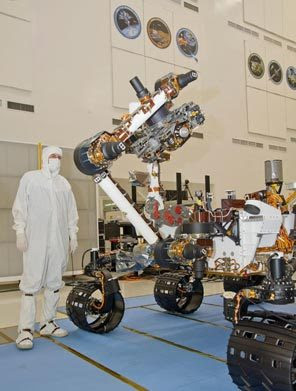
This NASA photo shows the Mars Science Laboratory rover, Curiosity, during testing June 3 at the Jet Propulsion Laboratory in Pasadena, Calif.
One of the most sophisticated space vehicles ever made inches along the rocky landscape, aluminum wheels grinding like a spoon in a garbage disposal.
Here in the Mars Yard at the Jet Propulsion Laboratory, what passes for the Red Planet looks like a vacant lot in Hesperia. The vehicle being tested, a replica of the latest Mars rover that will soon be crawling around up there, looks like a giant mechanical insect — six wheeled legs, an articulating arm and a pair of blue camera lenses like eyes peering from a boxy head.
On Friday, NASA's most ambitious Mars rover mission to date is scheduled to lift off from Cape Canaveral, Fla., aboard an Atlas V rocket. It's a $2.5 billion gamble scientists hope will give unparalleled insights into how Mars evolved and whether it ever could have supported life.T
The Mars Science Laboratory — nicknamed Curiosity — was developed at JPL in La Canada Flintridge, Calif., and will be the fourth rover to traverse the planet's harsh terrain. But unlike the earlier Mars rovers — Sojourner, Spirit and the still-cruising Opportunity — Curiosity will do more than look for evidence of water.
Curiosity is a robot astrobiologist. During a mission expected to last at least two years, the rover will use a battery of scientific instruments to analyze Mars' geology and atmosphere, looking for the elements and chemical compounds that are the building blocks of life.
Scientists hope the information Curiosity gathers will exponentially increase their understanding of Mars and bring us closer to answering the most profound and tantalizing of questions: Could life exist beyond Earth?
"Humans are hard-wired to want to know the answer to that," said Bill Nye, executive director of the Planetary Society, the Pasadena, Calif.-based nonprofit that advocates for space exploration. "If we found life on Mars, it would change everybody's view of our place in space."
Curiosity will take 8.5 months to travel the 354 million miles to Mars — and two years to cover about 14 miles of its surface.
The rover is expected to land Aug. 5 near the Martian equator inside Gale crater, a chasm about the combined size of Connecticut and Rhode Island, with a three-mile-high mountain of layered sedimentary rock at its bottom.
Scientists believe the crater, thought to date back billions of years to when Mars was warm and wet, will reveal the planet's evolutionary story the way the Grand Canyon's strata expose the history of Earth.
"It's going to be like reading a novel — and it's a long one," said John Grotzinger, the project's chief scientist. "It's going to be a wild journey looking into the guts of the history of Mars."
If Curiosity were a car, it would be advertised as fully loaded: six aluminum wheels that can be steered independently. A mounted laser to vaporize rock. Seventeen cameras, to take high-definition images, make scientific measurements and navigate the rover. A robotic arm to drill into rock and scoop up samples. Instruments to detect in those samples organic compounds and elements associated with life on Earth.
And under the hood: a nuclear-powered engine that will give Curiosity a top crawling speed of 2 inches per second.
A big load to land
All that hardware gives the rover a curb weight of a ton. That's five times heavier than its predecessor, which bounced along the Martian surface nestled inside huge protective air bags before coming to rest, like a beach ball tossed from a low-flying airplane.
"The air bags needed to land Curiosity would have been two or three times the weight of the rover itself," said Adam Steltzner, a JPL engineer in charge of ensuring the rover lands in one piece. "There's no landing rocket that could have handled that weight."
So Steltzner's team has engineered an innovative, multi-staged system that, unlike the beach-ball approach, will use sensors and advanced computer software to guide Curiosity's descent to a relatively pinpoint landing.
As planned, the craft carrying the rover will hit Mars' atmosphere at 13,000 mph. Thruster rockets will slow and steer the craft, positioning it for landing. At about 1,000 mph, a parachute will deploy and slam on the brakes. Finally, a "sky crane" will emerge from the craft's descent stage and gently lower a tethered Curiosity to the ground.
All this in just six minutes.
"It looks kind of crazy. And it's definitely novel," Steltzner said. "But we believe it to be a very simple process." The Curiosity rover is one of most complex projects in NASA's history. It's also $900 million over budget and two years late.
An audit released earlier this year by NASA's inspector general criticized managers for repeatedly underestimating the cost of working around the project's numerous technological hurdles — a common complaint of the agency through the years.
All this comes at a time of budget cutting at NASA and a lack of consensus among scientists and politicians as to where the U.S. space program ought to devote dwindling dollars.
"If this fails, it's going to be a disaster," said Nye of the Planetary Society. "Congress will become ever less trusting of the true costs of these missions and the ability of the people doing it."
But Nye says the 26-month delay has a huge upside: It reduced the risk of failure.
"Everyone involved is working very hard to make sure that this succeeds," he said.
The sky-crane landing system is key to a more ambitious future mission: a planned partnership with the European Space Agency to send a rover to collect rock and soil on Mars and cache the samples for an eventual return to Earth.
"There's no such thing as a perfect landing system on Mars," said Steve Squyres, lead scientist for the Spirit and Opportunity rovers. "It's a highly unpredictable environment. It's always possible that a gust of wind or a pointy rock could ruin your day."
Over the last 50 years, more orbiters, probes and rovers have been flung at Mars than any other corner of the cosmos except our moon.
Getting there hasn't been easy. About half of the dozens of spacecraft sent to Mars have either malfunctioned, crashed or disappeared.
Because it's the only planet in our solar system that could have sponsored life — the rest are too hot, too cold or made of gas — public expectations of early trips to Mars were so high that the results seemed disappointing even when the missions succeeded.
In the years since, Mars missions have methodically built a scientifically rigorous portrait of the planet that offer insights on Earth's early history and future.
With this in mind, JPL scientists are downplaying the likelihood that Curiosity might actually find organic matter — a key ingredient for life. Finding conditions that would signal that Mars once could have supported life would be breathtaking in itself.
"You can't promise more than you can deliver. That's what happened" before, said Grotzinger, the mission's chief scientist, a geologist new to the space game.
As wet sediment hardens to rock, organic material is destroyed. Finding even a shred of the stuff in early Earth rocks is extremely rare, Grotzinger said.
"This is like looking for a needle in haystack — and the haystack is the size of Mars," he said. "But that doesn't mean we won't try."
Friday, November 11, 2011
"Of the hundreds of places we could have landed, we've chosen the best place to find habitable environmen. Now we'll see if we find one."

If you think that people who believe in the possibility of extraterrestrial life are kooks, you probably haven't talked to a NASA space scientist in a while.
At a news conference on Thursday, Doug McCuistion, director of the Mars program for NASA, said that when the agency's newest Mars rover blasts off for the red planet on Nov. 25, one of its charges will be to discover if the planet contains (or contained) the ingredients of life.
"This mission will bridge the gap scientifically from our understanding of the planet being warmer and wetter than we probably believed, to not seeking life itself, but seeking signs of life," he said.
He reiterated: "This is not a life-seeking mission."
Think about the mission this way: If NASA were going to Mars looking for signs of pancakes instead of signs of life, on this trip it would be looking for flour and eggs, not pancake crumbs -- and definitely not pancakes.
In an interview with The Times, Joy Crisp, deputy project scientist for the Mars Science Laboratory, said the rover will be looking for organic molecules and isotopic signatures that might indicate that life did exist at one time on Mars.
"If this step pans out, if we do find organic compounds and we think that the rocks look likely to preserve evidence of life, then we will know better what to send next," she said. "It is kind of an intermediate step."
Asfor the rover itself -- called Curiosity -- it's 6-feet-tall, weighs roughly 2,000 pounds, and is the most complex machine to be placed on another planet, according to McCuistion.
The rover has high-definition cameras, a laser eye, and a weather station to help scientists monitor the environment. It also has the ability to sample rocks and soils, and a drill that will allow it to capture material from inside rocks.
"This is a Mars scientist dream machine," said Ashwin Vasavada, Mars Science Laboratory deputy project scientist, at the news event.
But the rover won't be landing on the planet for a while. Curiosity is scheduled to leave Earth on Nov. 25 (the day after Thanksgiving), but it won't be landing on Mars until August 2012.
During the news conference, Vasavada was asked how likely he thought it was that Curiosity would find evidence of life on Mars.
"That would be in the realm of speculation," he said, "but the reason we are excited about Mars is that when we look into the distant past, there is evidence of rivers flowing and lakes and we are trying to find out if they are habitable environments."
Subscribe to:
Posts (Atom)


