Showing posts with label Mars Rover Curiosity. Show all posts

Saturday, July 19, 2014

NASA's Curiosity Mars Rover finds Iron Meteorite called "Lebanon."


This rock encountered by NASA's Curiosity Mars rover is an iron meteorite called "Lebanon," similar in shape and luster to iron meteorites found on Mars by the previous generation of rovers, Spirit and Opportunity.  Lebanon is about 2 yards or 2 meters wide (left to right, from this angle). The smaller piece in the foreground is called "Lebanon B."
This view combines a series of high-resolution circular images taken by the Remote Micro-Imager (RMI) of Curiosity's Chemistry and Camera (ChemCam) instrument with color and context from rover's Mast Camera (Mastcam).  The component images were taken during the 640th Martian day, or sol, of Curiosity's work on Mars (May 25, 2014).
The imaging shows angular shaped cavities on the surface of the rock. One possible explanation is that they resulted from preferential erosion along crystalline boundaries within the metal of the rock.  Another possibility is that these cavities once contained olivine crystals, which can be found in a rare type of stony-iron meteorites called pallasites, thought to have been formed near the core-mantle boundary within an asteroid.
Iron meteorites are not rare among meteorites found on Earth, but they are less common than stony meteorites. On Mars, iron meteorites dominate the small number of meteorites that have been found. Part of the explanation could come from the resistance of iron meteorites to erosion processes on Mars.
ChemCam is one of 10 instruments in Curiosity's science payload. The U.S. Department of Energy's Los Alamos National Laboratory, in Los Alamos, New Mexico, developed ChemCam in partnership with scientists and engineers funded by the French national space agency (CNES), the University of Toulouse and the French national research agency (CNRS). More information about ChemCam is available at http://www.msl-chemcam.com .  The rover's MastCam was built by and is operated by Malin Space Science Systems, San Diego.
Credit: NASA/JPL-Caltech/LANL/CNES/IRAP/LPGNantes/CNRS/IAS/MSSS

Friday, February 21, 2014

Mars Rover Curiosity is driving backwards to prove it can be done if needed.

NASA's Curiosity Mars rover caught its own shadow in this image taken just after completing a backward drive of 329 feet (100.3 meters) on the 547th Martian day, or sol, of the rover's work on Mars (Feb. 18, 2014). NASA/JPL-Caltech
The 1-ton Curiosity rover covered 329 feet (100 meters) in reverse on Tuesday (Feb. 18). The maneuver — carried out over relatively smooth and benign ground — was designed to test out a strategy for reducing wear on the robot's six metal wheels, which have accumulated dings and holes at an increasing rate over the last few months, NASA officials said."We wanted to have backwards driving in our validated toolkit because there will be parts of our route that will be more challenging," Curiosity project manager Jim Erickson, of NASA's Jet Propulsion Laboratory in Pasadena, Calif., said in a statement.

Thursday, February 6, 2014

The Winter Olympics on Mars in 3D

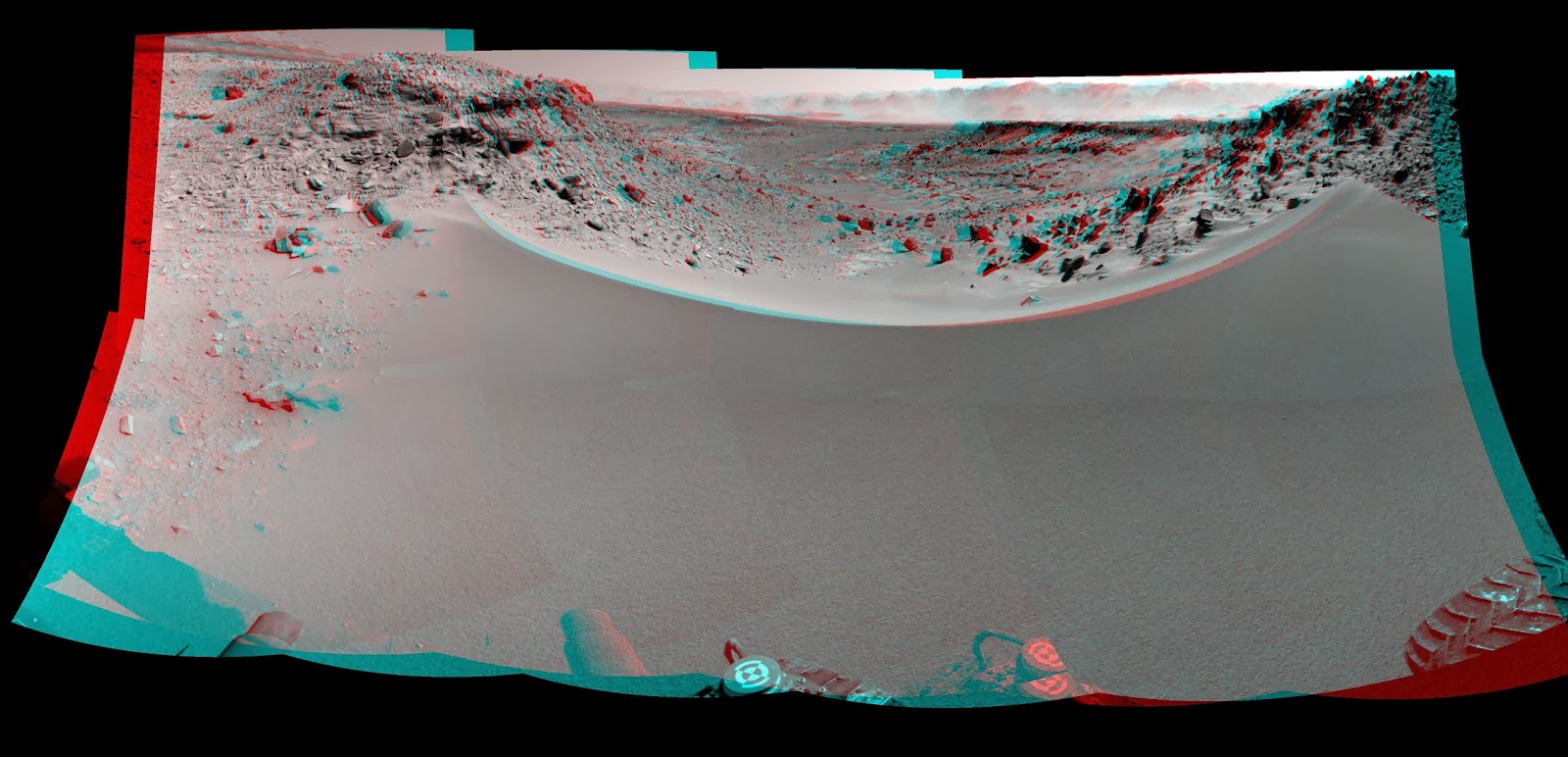
A new 3D image photo from NASA's Curiosity rover shows the car-sized robot at the lip of a small Martian sand dune, debating whether or not to drive over the obstacle on its way to a huge Red Planet mountain.

Thursday, September 19, 2013

Mars Rover Curiosity Detects No Methane in Martian Gas Samples at Ground Level: Hope of Life on Mars Fades.


Researchers using an unusually sensitive gas detector aboard the Mars Curiosity robot rover reported that they can't find any methane in the thin Martian air, dealing a blow to hopes that life today might be lurking in the soil of the cold, arid world.

"Methane on Mars would be an exciting find because most of the methane on Earth comes from life-related processes," such as microbial activity or organic decay, said planetary scientist Malynda Chizek at New Mexico State University who studies the planet's atmosphere. "Everyone wants to be the one who discovers life on Mars."

Upon the first close inspection at ground level on Mars, however, the crucial methane gas was nowhere to be found by Mars Rover Curiosity.

More Mars probes, including India's first mission to the planet and a $1 billion European effort with Russia, are poised to search for methane there in the years ahead. In light of the new finding, some researchers now doubt these efforts will find any evidence of the life-related gas.

Since 2003, astronomers using Earth-based telescopes and readings from a European satellite orbiting Mars have reported detecting periodic plumes of methane on Mars—up to 50 parts per billion in the air. Although often challenged by other researchers, those readings raised expectations among astrobiologists that microbes might be at work on the planet.

Saturday, August 3, 2013

Still Rocking and Rolling afer ONE YEAR on Mars! :Jet Propulsion Laboratory (JPL) in California can still produce a pretty compelling movie

Jet Propulsion Laboratory (JPL)uploaded a video that shows what the past year has been like for the Curiosity rover in under 2 minutes. Black and white video of dirt being drilled and analyzed might not be interesting to many; however, Curiosity is slowly traveling towards the planet's own Mount Sharpe, yet the landscape looks like many of the deserts on Earth. It's rocky, barren, and bathed in a bright and expansive sky. Watch the video here with a heavy Rock and Roll sound track... and it might take your breath away. (Space.com version with music) http://youtu.be/p83pSCm5ZMU

Thursday, July 25, 2013

Mars Rover Curiosity was captured by NASA's Mars Reconnaissance Orbiter (MRO) on its way to Mount Sharp


Mars Rover Curiosity  was captured by NASA's Mars Reconnaissance Orbiter (MRO) on its way to Mount Sharp


Mars Rover Curiosity Rover captured by NASA's Mars Reconnaissance Orbiter (MRO) as it makes its way to Mount Sharp, leaving a weaving set of tracks in its wake. The image released today by NASA scientists, shows Rover making its way across the planet, leaving tracks back to a dark, blast spot on the surface of Mars. That spot called the 'Bradbury Landing' is where Mars Rover Curiosity landed on Mars, named after the late science fiction author Ray Bradbury.

Thursday, June 6, 2013


Image Caption: Curiosity Points to Mount Sharp. Curiosity unstowed the robotic arm on Aug. 20 and aimed it directly at her Martian drive destination – Mount Sharp. This mosaic of the robotic arm was assembled from navigation camera images from Sols 2, 12 and 14 and shows 18,000 foot high Mount Sharp in the background and the shadow of the martian robot’s head at center. Curiosity will search for hydrated minerals using the robotic arm and a neutron detector on the body. Image stitching and processing by Ken Kremer and Marco Di Lorenzo. Credit: NASA/JPL-Caltech/Ken Kremer/Marco Di Lorenzo


Read more: http://www.universetoday.com/96932/curiosity-takes-aim-at-martian-destination-mount-sharp/#ixzz2VRMSEQLu
After investigating for ten months at the plains, NASA’s Mars rover Curiosity is set to move toward the mountains in search for favorable habitats that could be suitable for microbial life.
According to deputy project scientist Joy Crisp from NASA's Jet Propulsion Laboratory, the journey to “Mount Sharp” will be a long one. "This truly is a mission of exploration, so just because our end goal is Mount Sharp does not mean we are not going to investigate interesting features along the way."
"We're going to keep our eyes open as we drive and if we in fact drive past something that's amazing, we might actually turn around and go back and check it out, but there's nothing that we see from orbit that's like some super-compelling clue to life or something like that," Crisp said.
"What we have is a real desire to get to Mount Sharp.”

Considered as the “biggest turning point since landing” of Curiosity, NASA hopes that investigations at “Mount Sharp” will unearth new evidence of life-friendly habitats on Mars. From the images of Mount Sharp taken from orbit and images Curiosity has taken from a distance, scientists have figured out many layers in the area, which may offer significant information on how the ancient Martian environment changed and evolved.

Scientists said the Mars Science Laboratory mission has already accomplished its main science objective. Analysis of rock powder from the first drilled rock target, "John Klein," provided evidence that an ancient environment in Gale Crater had favorable conditions for microbial life -- the essential elemental ingredients, energy and ponded water that was neither too acidic nor too briny.

Saturday, March 23, 2013

Curiosity is back, baby!

Feast your eyes on the latest Mars panorama, shared generously by Ken Kremer and Marco Di Lorenzo (and based on the cool imagery from NASA and JPL-Caltech).


http://photoblog.nbcnews.com/_news/2013/03/23/17431884-mars-curiosity-rover-gets-back-to-sending-snapshots?lite

Monday, February 11, 2013

NASA's Curiosity rover has drilled into a Martian rock and collected samples, marking the first time any robot has ever performed this complicated maneuver on the surface of another planet.

At the center of this image from NASA's Curiosity rover is the hole in a rock called "John Klein" where the rover conducted its first sample drilling on Mars. The drilling took place on Feb. 8, 2013.


CREDIT: NASA/JPL-Caltech/MSSS

PASADENA, Calif. -- NASA's Curiosity rover has, for the first time, used a drill carried at the end of its robotic arm to bore into a flat, veiny rock on Mars and collect a sample from its interior. This is the first time any robot has drilled into a rock to collect a sample on Mars.


The fresh hole, about 0.63 inch (1.6 centimeters) wide and 2.5 inches (6.4 centimeters) deep in a patch of fine-grained sedimentary bedrock, can be seen in images and other data Curiosity beamed to Earth Saturday. The rock is believed to hold evidence about long-gone wet environments. In pursuit of that evidence, the rover will use its laboratory instruments to analyze rock powder collected by the drill.


"The most advanced planetary robot ever designed is now a fully operating analytical laboratory on Mars," said John Grunsfeld, NASA associate administrator for the agency's Science Mission Directorate. "This is the biggest milestone accomplishment for the Curiosity team since the sky-crane landing last August, another proud day for America."


For the next several days, ground controllers will command the rover's arm to carry out a series of steps to process the sample, ultimately delivering portions to the instruments inside.


"We commanded the first full-depth drilling, and we believe we have collected sufficient material from the rock to meet our objectives of hardware cleaning and sample drop-off," said Avi Okon, drill cognizant engineer at NASA's Jet Propulsion Laboratory, Pasadena, Calif.


Rock powder generated during drilling travels up flutes on the bit. The bit assembly has chambers to hold the powder until it can be transferred to the sample-handling mechanisms of the rover's Collection and Handling for In-Situ Martian Rock Analysis (CHIMRA) device.


Before the rock powder is analyzed, some will be used to scour traces of material that may have been deposited onto the hardware while the rover was still on Earth, despite thorough cleaning before launch.


"We'll take the powder we acquired and swish it around to scrub the internal surfaces of the drill bit assembly," said JPL's Scott McCloskey, drill systems engineer. "Then we'll use the arm to transfer the powder out of the drill into the scoop, which will be our first chance to see the acquired sample."


"Building a tool to interact forcefully with unpredictable rocks on Mars required an ambitious development and testing program," said JPL's Louise Jandura, chief engineer for Curiosity's sample system. "To get to the point of making this hole in a rock on Mars, we made eight drills and bored more than 1,200 holes in 20 types of rock on Earth."


Inside the sample-handling device, the powder will be vibrated once or twice over a sieve that screens out any particles larger than six-thousandths of an inch (150 microns) across. Small portions of the sieved sample will fall through ports on the rover deck into the Chemistry and Mineralogy (CheMin) instrument and the Sample Analysis at Mars (SAM) instrument. These instruments then will begin the much-anticipated detailed analysis.


The rock Curiosity drilled is called "John Klein" in memory of a Mars Science Laboratory deputy project manager who died in 2011. Drilling for a sample is the last new activity for NASA's Mars Science Laboratory Project, which is using the car-size Curiosity rover to investigate whether an area within Mars' Gale Crater has ever offered an environment favorable for life.


JPL manages the project for NASA's Science Mission Directorate in Washington.


For images and more information about the mission, visit: http://www.nasa.gov/msl and http://mars.jpl.nasa.gov/msl/ .


You can follow the mission on Facebook and Twitter at: http://www.facebook.com/marscuriosity and http://www.twitter.com/marscuriosity .


Guy Webster 818-354-6278

Jet Propulsion Laboratory, Pasadena, Calif.

guy.webster@jpl.nasa.gov


Dwayne Brown 202-358-1726

NASA Headquarters, Washington

dwayne.c.brown@nasa.gov


2013-052


Sunday, December 2, 2012

Mars just seems to have that effect on people.


The next news conference about the NASA Mars rover Curiosity will be held at 9 a.m. PST(12 p.m. EST) Monday, Dec. 3, in San Francisco at the Fall Meeting of the American Geophysical Union (AGU). 

Rumors and speculation that there are major new findings from the mission at this early stage are incorrect. The news conference will be an update about first use of the rover's full array of analytic instruments to investigate a drift of sandy soil. One class of substances Curiosity is checking for is organic compounds -- carbon-containing chemicals that can be ingredients for life. At this point in the mission, the instruments on the rover have not detected any definitive evidence of Martian organics. - JPL NEWS RELEASE 2012-377b
As noted in an earlier posting here, the director of NASA's Jet Propulsion Laboratory said last week that preliminary data showed the possibility that the agency's Mars Science Laboratory  –  better knowed as Curiosity — had found signs of carbon-containing molecules as "one for the history books."
According to the above  JPL news release, there will be no major announcements Monday in San Francisco at the  annual meeting of American Geophysical Union. 
The science team is continuing to try and verify what the rover has found. "Carbon compounds are  a substance that's consistent with biological materials," says John Grotzinger of the California Institute of Technology, the chief scientist on the rover team, but Grotzinger says it doesn't have to be biological materials; there are plenty of carbon-containing compounds that have nothing to do with life.
However, finding these carbon molecules would be exciting because of what it might say about the Martian environment where the rover is sitting at the bottom of Gale crater. If one kind of carbon can survive there, it might just be a place where carbon molecules that are related to living organisms could also survive as a kind of chemical fossil.
"There wouldn't be a field of paleontology unless you found the hot spots where things get preserved," Grotzinger says. The NASA Mars rover Curiosity  is looking for those hot spots; places where carbon-containing chemicals consistent with life might have been preserved and still exist. "[But] even if they have nothing to do with life, at least it tells us that this is the kind of environment that might have been favorable for preservation of something that could be a biological material," he says.
Even the possibility of finding carbon compounds on Mars causes excitement, which certainly is not true for every planet. In the current issue of the Journal Science, researchers reported they were virtually certain that had found large deposits of organic compounds on the planet Mercury, and that wasn't front page news. 
"I can tell you anytime when you find anything with Mars, it's a frenzy," says Maria Zuber of the Massachusetts Institute of Technology, one of the Mercury researchers who also works on Mars.

Wednesday, November 21, 2012

For now, though, we'll have to wait to see what's got Mars rover scientists itching to say what they found.


NASA's Mars rover Curiosity dug up five scoops of sand from a patch nicknamed "Rocknest." A suite of instruments called SAM analyzed Martian soil samples, but the findings have not yet been released. (NASA/JPL-Caltech)


http://www.wbur.org/npr/165513016/big-news-from-mars-rover-scientists-mum-for-now

Scientists working on NASA's six-wheeled rover on Mars have a problem. But it's a good problem.


They have some exciting new results from one of the rover's instruments. On the one hand, they'd like to tell everybody what they found, but on the other, they have to wait because they want to make sure their results are not just some fluke or error in their instrument.It's a bind scientists frequently find themselves in, because by their nature, scientists like to share their results. At the same time, they're cautious because no one likes to make a big announcement and then have to say "never mind."


They have some exciting new results from one of the rover's instruments. On the one hand, they'd like to tell everybody what they found, but on the other, they have to wait because they want to make sure their results are not just some fluke or error in their instrument.


It's a bind scientists frequently find themselves in, because by their nature, scientists like to share their results. At the same time, they're cautious because no one likes to make a big announcement and then have to say "never mind."

The exciting results are coming from an instrument in the rover called SAM. "We're getting data from SAM as we sit here and speak, and the data looks really interesting," John Grotzinger, the principal investigator for the rover mission, says during my visit last week to his office at NASA's Jet Propulsion Laboratory in Pasadena, Calif. That's where data from SAM first arrive on Earth. "The science team is busily chewing away on it as it comes down," says Grotzinger.


SAM is a kind of miniature chemistry lab. Put a sample of Martian soil or rock or even air inside SAM, and it will tell you what the sample is made of.


Grotzinger says they recently put a soil sample in SAM, and the analysis shows something earthshaking. "This data is gonna be one for the history books. It's looking really good," he says.


Grotzinger can see the pained look on my face as I wait, hoping he'll tell me what the heck he's found, but he's not providing any more information.


So why doesn't Grotzinger want to share his exciting news? The main reason is caution. Grotzinger and his team were almost stung once before. When SAM analyzed an air sample, it looked like there was methane in it, and at least here on Earth, some methane comes from living organisms.


But Grotzinger says they held up announcing the finding because they wanted to be sure they were measuring Martian air, and not air brought along from the rover's launchpad at Cape Canaveral.


"We knew from the very beginning that we had this risk of having brought air from Florida. And we needed to diminish it and then make the measurement again," he says. And when they made the measurement again, the signs of methane disappeared.


Grotzinger says it will take several weeks before he and his team are ready to talk about their latest finding. In the meantime he'll fend off requests from pesky reporters, and probably from NASA brass as well. Like any big institution, NASA would love to trumpet a major finding, especially at a time when budget decisions are being made. Nothing succeeds like success, as the saying goes.


Richard Zare, a chemist at Stanford University, appreciates the uncomfortable position John Grotzinger is in. He's been there. In 1996, he was part of a team that reported finding organic compounds in a meteorite from Mars that landed in Antarctica. When the news came out, it caused a huge sensation because finding organic compounds in a Martian rock suggested the possibility at least that there was once life on Mars.


"You're bursting with a feeling that you want to share this information, and it's frustrating when you feel you can't talk about it, "says Zare.


It wasn't scientific caution that kept Zare from announcing his results. It was a rule many scientific journals enforce that says scientists are not allowed to talk about their research until the day it's officially published. Zare had to follow the rules if he wanted his paper to come out.


He did break down and tell his family. "I remember at the dinner table with great excitement explaining to my wife, Susan, and my daughter, Bethany, what it was we were doing," says Zare. And then he experienced something many parents can relate to when talking to their kids.

"Bethany looked at me and said, 'pass the ketchup.' So, not everybody was as excited as I was," he says.
Zare says in a way, scientists are like artists. Sharing what they do is a big part of why they get out of bed in the morning.


"How many composers would actually compose music if they were told no one else could listen to their compositions? How many painters would make a painting if they were told no one else could see them?" says Zare. It's the same for scientists. "The great joy of science is to be able to share it. And so you want to say, 'Isn't this interesting? Isn't that cool?' "


Was there Life on Mars?

Today, November 20, 2012, a discovery was made that N.A.S.A. is not ready to reveal to the public, but Curiosity chief scientist, John Grotzinger stated, “This data is gonna be one for the history books. It’s looking really good”. They say that they are delaying their revelation to the public until they have an opportunity to check and recheck their data, but that they will be revealing this exciting news at the fall meeting of the American Geophysical Union, which takes place December 3-7 in San Francisco.


This discovery was made by using Curiosity’s Sample Analysis at Mars instrument, which is controlled by a robotic arm. Sam is Curiosity’s onboard chemistry lab, and it is capable of identifying organic compounds, which are the carbon containing building blocks of life. Sam obviously has detected something very interesting and exciting while taking and analyzing samples, and the excitement that is being presented suggests that whatever was found will not only answer all the questions we have had about life on Mars, but will change the way we view the planet that we have speculated about for centuries. It is exciting to know that we may finally have the answers that we have searched so long for.

This has been a great year for the scientific community and for the American people. We will be waiting for this exciting announcement with great anticipation. Congratulations N.A.S.A. on your new discovery, and thank you for all your hard work and dedication to this mission.


As always, thank you to my loyal readers, and if you enjoyed this article, please be sure repost the article to your Facebook or Twitter page so others can enjoy it. I wish everyone a wonderful Thanksgiving holiday. I hope you have a great day with your family and friends.


A special thank you goes out to Space.com  the facts for this article.

Friday, November 9, 2012

No Methane. No Life on Mars.


Mars Science Laboratory (MSL) Rover Curiosity has  found no methane in the Martian atmosphere, making it unlikely that there is  life on Mars. Mars Rover Curiosity  took this self-portrait.
The methane discovery (or lack thereof) comes from the first analysis of Martian atmosphere, taken by the Sample Analysis at Mars (SAM) instrument aboard Curiosity. SAM took a small gulp of Martian air and analyzed it with the Quadrupole Mass Spectrometer and the Tunable Laser Spectrometer — and in both cases, the sensors failed to detect any methane. This does not mean that there’s no methane at all, but it means there is no measurable amount  methane per billion parts of Martian atmosphere.

Saturday, September 15, 2012

The blueberries recently discovered by Opportunity — which is still chugging along after eight years, and with less fanfare than the rover-of-the-minute Curiosity

The above picture may not look like much, but it could be a huge deal. The photograph, taken by the Opportunity Rover at Mars’ Cape York site, shows iron spherules that researchers commonly refer to as “blueberries.” Similar formations are found here on Earth. The catch is that, here, they are formed with help from microbial organisms, suggesting that these unassuming iron marbles could be a telltale sign of ancient life on the red planet.

Typically just a couple millimeters across, iron blueberries are a pretty standard part of the Martian landscape, found on the ground of the Cape York site where Opportunity is doing its research or embedded in rock. They bear a distinct resemblance to the “Moqui marbles” found around the American southwest. Ranging in size rom BB pellets to cannonballs, Moqui marbles are not unlike geological M&Ms, consisting of a thin iron shell filled will sand.
A study published earlier this month in the journal Geology found strong evidence that the marbles are not a purely geological oddity, but were formed with an assist from microbes. That finding is a strong suggestion that the Moqui marbles’ Martian cousins may be a good candidate for indicators that Mars once sustained microbial life.
The blueberries recently discovered by Opportunity — which is still chugging along after eight years, and with less fanfare than the rover-of-the-minute Curiosity — are in an area not known for its iron content, but for the possibility that it may have clay deposits, suggesting it may once have been a site for flowing water. Between those two findings, Opportunity could certainly be in worse places to look for ancient martian microbes. The search for those signs is still akin to looking for a needle in a haystack, of course, but the haystack may have just gotten a lot smaller.
(via PhysOrg, University of Nebraska-Lincoln, image courtesy of NASA)