Showing posts with label Life on Mars. Show all posts

Wednesday, May 6, 2015

'The Martian' author Andy Weir is less optimistic about getting to Mars than NASA


"The Martian" was reviewed on this blog.
"During a manned mission to Mars, Astronaut Mark Watney is presumed dead after a fierce storm and left behind by his crew. But Watney has survived and finds himself stranded and alone on the hostile planet. With only meager supplies, he must draw upon his ingenuity, wit and spirit to subsist and find a way to signal to Earth that he is alive." - IMDA
Director:
Writers: (screenplay), (book)
The book is soon to be a movie starring Matt Damon, but the book's author Andy Weir is surprisingly less optimistic than NASA about the likelihood of humans making it to Mars, "My stock answer is probably around 2050," Weir told the audience assembled at this week's Humans to Mars conference at The George Washington University.

"I know that sounds further away than most people would like to hear, but the technology necessary to get there and the costs of getting there are just very high and it's a big challenge."  This was not the timeline that NASA announced at the same conference:  NASA space agency's head, Charles Bolden, opened the conference by announcing a timeline that puts USA astronauts on Mars in the 2030s, a goal that Bolden insisted NASA is on track to meet. In response to a question, Weir told the audience that his own 2050 estimate for getting humans to Mars "might be optimistic," going on to recall that during the Apollo missions, many thought we'd be on Mars by the 1980s.

Weir supports creating a colony on Mars so that humanity can become less dependent on Earth. "I would like to have a self-sufficient colony of humans and other species somewhere other than Earth," he said. "I'm a 25-year-veteran software engineer and I think it's important to back things up."

Monday, April 21, 2014

Asteroid Impact Glass May Reveal Ancient Life on Mars

In a new study, scientists have analyzed ancient materials preserved astonishingly in glass generated by an asteroid's collision with the Earth.


According to BBC News, the scientists published their new study in the journal Geology. The samples were found in the Pampas in Argentina and represent a new way of looking into the environmental history of other planets, Mars in particular.

Tuesday, February 11, 2014

"The Martian" by Andy Weir... "For the record, I didn't die on Sol-6... I might be the first human being to die on Mars...."

He got the idea for "The Martian" in 2009, and spent three years working out the details of the story. He drew on a real NASA proposal for a Mars mission called Mars Direct, which involves sending supplies in unmanned ships to Mars ahead of the crew, then sending astronauts in a lighter, faster ship. He'd been rebuffed by literary agents in the past, so he decided to put the novel on his website free of charge rather than to try to get it published. A few fans asked him to sell the story on Amazon so that they could download it to e-readers. Mr. Weir had been giving his work away, but he began charging a modest amount because Amazon set the minimum price at 99 cents. He published the novel as a serial on the site in September 2012. It rose to the top of Amazon's list of best-selling science-fiction titles. He sold 35,000 copies in three months. Agents and publishers and movie studios started circling. Mr. Weir signed with literary agent David Fugate, who sent 'The Martian' to Julian Pavia at Crown, pitching it as "Apollo 13" meets "Castaway" and Crown bought it last March for six figures. The same week Crown pounced, Twentieth Century Fox optioned film rights, beating out several other studios and producers. Fox hired screenwriter Drew Goddard, who wrote the sci-fi film "Cloverfield," to adapt and direct "The Martian."

READ MORE ABOUT "The Martian"
http://www.washingtonpost.com/entertainment/books/andy-weir-delivers-with-the-martian/2014/02/11/e648d37c-934e-11e3-b3f7-f5107432ca45_story.html

http://online.wsj.com/news/articles/SB10001424052702304558804579375161461671196?mg=reno64-wsj&url=http%3A%2F%2Fonline.wsj.com%2Farticle%2FSB10001424052702304558804579375161461671196.html

http://www.avclub.com/review/the-martian-makes-the-tale-of-an-engineer-stranded-201074

UPDATE: I am now 60% through "The Martian" by Andy Weir... a $9 Kindle version which tells me percentages and not pages read. When I first started teaching decades ago, I imagined a semester long book project for my IPC students about a trip to Mars and with it all the Physics, Chemistry, (and yes Biology) that would involve. Like most being science teachers, I was fresh, new, and naive. Now retired. That project was never accomplished. Lots of trials and research, but nothing truly engaging or inspiring. Andy Weir's first novel, "The Martian", deserves your attention as a common reading book project for a second semester, rite of Spring, wake'em up project. I have tried Heinlein and Bova and Robinson in the past but Weir is a fresh, well written, and very thought provoking read. The hard science topics are both obvious and well presented to the reader... any science teacher will be excited by potential of classroom and lab activities it invokes. Live or Die on Mars, Martin Watney's tale is compelling... only 40% more to go til I find out how it all comes out. You can read the first chapter and the author presentation at Space.com here: http://www.space.com/24721-chapter-one-of-the-martian.html

Thursday, February 6, 2014

AstroBiology Magazine: Lichen Life on Mars. What is possible?

The lichen chosen for the experiment, called P. chlorophanum, has proven itself a survival champion even before the Mars simulation. Researchers removed lichen samples for testing from its home atop the rocky Black Ridge in Antarctica's North Victoria Land — a frozen, dry landscape not unlike that of many places on Mars.

Reported in AstroBiology Magazine:
Humans cannot hope to survive life on Mars without plenty of protection from the surface radiation, freezing night temperatures and dust storms on the red planet. So they could be excused for marveling at humble Antarctic lichen that has shown itself capable of going beyond survival and adapting to life in simulated Martian conditions.

The mere feat of surviving temperatures as low as -51 degrees C and enduring a radiation bombardment during a 34-day experiment might seem like an accomplishment by itself. But the lichen, a symbiotic mass of fungi and algae, also proved it could adapt physiologically to living a normal life in such harsh Martian conditions — as long as the lichen lived under "protected" conditions shielded from much of the radiation within "micro-niches" such as cracks in the Martian soil or rocks.

"There were no studies on adaptation to Martian conditions before," said Jean-Pierre de Vera, a scientist at the German Aerospace Center's Institute of Planetary Research in Berlin, Germany. "Adaptation is very important to be investigated, because it tells you more about the interactions of life in relation to its environment."
READ MORE : http://www.astrobio.net/exclusive/5932/lichen-on-mars http://www.astrobio.net/exclusive/5932/lichen-on-mars

Thursday, September 19, 2013

Mars Rover Curiosity Detects No Methane in Martian Gas Samples at Ground Level: Hope of Life on Mars Fades.


Researchers using an unusually sensitive gas detector aboard the Mars Curiosity robot rover reported that they can't find any methane in the thin Martian air, dealing a blow to hopes that life today might be lurking in the soil of the cold, arid world.

"Methane on Mars would be an exciting find because most of the methane on Earth comes from life-related processes," such as microbial activity or organic decay, said planetary scientist Malynda Chizek at New Mexico State University who studies the planet's atmosphere. "Everyone wants to be the one who discovers life on Mars."

Upon the first close inspection at ground level on Mars, however, the crucial methane gas was nowhere to be found by Mars Rover Curiosity.

More Mars probes, including India's first mission to the planet and a $1 billion European effort with Russia, are poised to search for methane there in the years ahead. In light of the new finding, some researchers now doubt these efforts will find any evidence of the life-related gas.

Since 2003, astronomers using Earth-based telescopes and readings from a European satellite orbiting Mars have reported detecting periodic plumes of methane on Mars—up to 50 parts per billion in the air. Although often challenged by other researchers, those readings raised expectations among astrobiologists that microbes might be at work on the planet.

Thursday, June 6, 2013


Image Caption: Curiosity Points to Mount Sharp. Curiosity unstowed the robotic arm on Aug. 20 and aimed it directly at her Martian drive destination – Mount Sharp. This mosaic of the robotic arm was assembled from navigation camera images from Sols 2, 12 and 14 and shows 18,000 foot high Mount Sharp in the background and the shadow of the martian robot’s head at center. Curiosity will search for hydrated minerals using the robotic arm and a neutron detector on the body. Image stitching and processing by Ken Kremer and Marco Di Lorenzo. Credit: NASA/JPL-Caltech/Ken Kremer/Marco Di Lorenzo


Read more: http://www.universetoday.com/96932/curiosity-takes-aim-at-martian-destination-mount-sharp/#ixzz2VRMSEQLu
After investigating for ten months at the plains, NASA’s Mars rover Curiosity is set to move toward the mountains in search for favorable habitats that could be suitable for microbial life.
According to deputy project scientist Joy Crisp from NASA's Jet Propulsion Laboratory, the journey to “Mount Sharp” will be a long one. "This truly is a mission of exploration, so just because our end goal is Mount Sharp does not mean we are not going to investigate interesting features along the way."
"We're going to keep our eyes open as we drive and if we in fact drive past something that's amazing, we might actually turn around and go back and check it out, but there's nothing that we see from orbit that's like some super-compelling clue to life or something like that," Crisp said.
"What we have is a real desire to get to Mount Sharp.”

Considered as the “biggest turning point since landing” of Curiosity, NASA hopes that investigations at “Mount Sharp” will unearth new evidence of life-friendly habitats on Mars. From the images of Mount Sharp taken from orbit and images Curiosity has taken from a distance, scientists have figured out many layers in the area, which may offer significant information on how the ancient Martian environment changed and evolved.

Scientists said the Mars Science Laboratory mission has already accomplished its main science objective. Analysis of rock powder from the first drilled rock target, "John Klein," provided evidence that an ancient environment in Gale Crater had favorable conditions for microbial life -- the essential elemental ingredients, energy and ponded water that was neither too acidic nor too briny.

Saturday, June 1, 2013

Ageing Mars rover Opportunity has found evidence that the conditions for ancient life once existed on the Red planet.

Above NASA Photo: Preliminary interpretation points to
clay mineral content  due to intensive alteration by water.


Mars Rover Opprotunity has been wandering on Mars since 2004, and it is still producing useful science.
Its remarkable longevity has astounded and delighted Nasa officials, who initially expected that it would last for just 90 Martian days. Instead it is continuing to roll along the surface, 37 times longer than anybody thought it would.

Its latest discovery is one of its most exciting, Nasa officials said: an area of rock which was clearly weathered by large amounts of water, indicating that the conditions for life once existed on the planet.
The exposed  rock ( called "Esperance") is unlike any the rover has previously found, fractured and weathered by conditions that were "possibly favorable for life", Nasa said. The new pictures were taken at Cape York, an area on the rim of the massive Endeavour crater.


Monday, March 18, 2013

Is there life on Mars? Why the question still eludes NASA...

Is there life on Mars?
Why the question still eludes us after 40 years of  NASA discovery on Mars?

 NASA is slowly learning where to look for microbes on the Red Planet, but there are no answers yet

 By Carl Franzen

"For NASA, nearly 40 years after it first landed on Mars, it remains too early to make that call. The agency right now is just concerned with proving habitability, which the Curiosity rover seems to have effectively done. NASA's next mission to Mars, an orbital craft called MAVEN, is due to launch later this year to study Mars's atmosphere. The mission after that, InSight, due to launch in 2016, will be another lander that will bore deeper into Mars than even Curiosity can, revealing yet more data on Mars' past. Still, it's doubtful either of these missions will settle the question of life once and for all."

READ all of the article at : http://www.theverge.com/2013/3/14/4100578/life-on-mars-still-elusive-after-curiosity-viking-other-discoveries

Tuesday, March 12, 2013

The Chances of Life Being in Mars' History Just Got Better.

This image released by NASA shows the Curiosity rover holding a scoop of powdered rock on Mars. The rover recently drilled into a Martian rock for the first time and transferred a pinch of powder to its instruments to analyze the chemical makeup. Credit NASA

Mars's Gale Crater was habitable in its distant past, perhaps during the same period in which microbial life was establishing itself on Earth between 3 billion and 4 billion years ago.

The issue of habitability is "in the bag," said John Grotzinger, a planetary geologist at the California Institute of Technology in Pasadena, Calif., and the mission's lead scientist, during a press briefing announcing the results today, March 12, 2013.


The minerals in the tiny, gray, ground-rock sample exposed by Curiosity's drill speak of abundant standing water, conditions neither too acidic or too alkaline for life, and the minerals that would have provided a ready energy source for microbes, if any had been there.


The water in the Gale Crater  being explored by Curiosity would have been "so benign and supportive of life that probably if this water was around and you had been on the planet, you would have been able to drink it," Grotzinger said.   Did Mars ever host environments suitable for life?   Yes is the conclusion scientists have reached after NASA's Mars rover Curiosity analyzed the first sample ever culled from deep in a rock on another planet. Curiosity used a first-of-its-kind drill to extract the sample.

Sunday, December 2, 2012

Mars just seems to have that effect on people.


The next news conference about the NASA Mars rover Curiosity will be held at 9 a.m. PST(12 p.m. EST) Monday, Dec. 3, in San Francisco at the Fall Meeting of the American Geophysical Union (AGU). 

Rumors and speculation that there are major new findings from the mission at this early stage are incorrect. The news conference will be an update about first use of the rover's full array of analytic instruments to investigate a drift of sandy soil. One class of substances Curiosity is checking for is organic compounds -- carbon-containing chemicals that can be ingredients for life. At this point in the mission, the instruments on the rover have not detected any definitive evidence of Martian organics. - JPL NEWS RELEASE 2012-377b
As noted in an earlier posting here, the director of NASA's Jet Propulsion Laboratory said last week that preliminary data showed the possibility that the agency's Mars Science Laboratory  –  better knowed as Curiosity — had found signs of carbon-containing molecules as "one for the history books."
According to the above  JPL news release, there will be no major announcements Monday in San Francisco at the  annual meeting of American Geophysical Union. 
The science team is continuing to try and verify what the rover has found. "Carbon compounds are  a substance that's consistent with biological materials," says John Grotzinger of the California Institute of Technology, the chief scientist on the rover team, but Grotzinger says it doesn't have to be biological materials; there are plenty of carbon-containing compounds that have nothing to do with life.
However, finding these carbon molecules would be exciting because of what it might say about the Martian environment where the rover is sitting at the bottom of Gale crater. If one kind of carbon can survive there, it might just be a place where carbon molecules that are related to living organisms could also survive as a kind of chemical fossil.
"There wouldn't be a field of paleontology unless you found the hot spots where things get preserved," Grotzinger says. The NASA Mars rover Curiosity  is looking for those hot spots; places where carbon-containing chemicals consistent with life might have been preserved and still exist. "[But] even if they have nothing to do with life, at least it tells us that this is the kind of environment that might have been favorable for preservation of something that could be a biological material," he says.
Even the possibility of finding carbon compounds on Mars causes excitement, which certainly is not true for every planet. In the current issue of the Journal Science, researchers reported they were virtually certain that had found large deposits of organic compounds on the planet Mercury, and that wasn't front page news. 
"I can tell you anytime when you find anything with Mars, it's a frenzy," says Maria Zuber of the Massachusetts Institute of Technology, one of the Mercury researchers who also works on Mars.

Tuesday, November 27, 2012

Elon Musk doesn’t just want to send a person to Mars — he wants to send 80,000.

This still from a SpaceX mission concept video shows a Dragon space capsule landing on the surface of Mars. SpaceX's Dragon is a privately built space capsule to carry unmanned payloads, and eventually astronauts, into space. CREDIT: SpaceX

According to Space.com, the billionaire founder and CEO of the private spaceflight company SpaceX gave details about his hopes for a future Mars colony during a talk at the Royal Aeronautical Society in London on Nov. 16.


Earlier this year, SpaceX became the first private U.S. company to deliver cargo to the International Space Station. Musk has never been shy about his ambitions to take human colonists to another planet, mentioning in the past that he wants to provide flights to Mars for about $500,000 a person. But now he’s talking about building a small-city-sized settlement on the Red Planet, starting with a 10-person crew in the coming decades to begin establishing and building infrastructure.

"That first flight would be expensive and risky but once there are regular Mars flights, you can get the cost down to half a million dollars for someone to move to Mars,” Musk told Space.com. "Then I think there are enough people who would pay that much to live on Mars to have it be a reasonable business case.”

Musk added that he sees the future 80,000-person colony as a public-private enterprise costing roughly $36 billion.

Science-fiction inspired plans are one thing. Musk still has many challenges ahead of him before such a scheme could become reality, including figuring out exactly how to deal with radiation on the way to Mars, how to land humans on the planet’s surface, and how to keep them alive once there. Wired Magazine Editor Chris Anderson interviewed Musk in the November issue, here he outlines a few ways that could help us get there: 
http://www.wired.com/wiredscience/2012/11/elon-musk-mars-colony/

Wednesday, November 21, 2012

For now, though, we'll have to wait to see what's got Mars rover scientists itching to say what they found.


NASA's Mars rover Curiosity dug up five scoops of sand from a patch nicknamed "Rocknest." A suite of instruments called SAM analyzed Martian soil samples, but the findings have not yet been released. (NASA/JPL-Caltech)


http://www.wbur.org/npr/165513016/big-news-from-mars-rover-scientists-mum-for-now

Scientists working on NASA's six-wheeled rover on Mars have a problem. But it's a good problem.


They have some exciting new results from one of the rover's instruments. On the one hand, they'd like to tell everybody what they found, but on the other, they have to wait because they want to make sure their results are not just some fluke or error in their instrument.It's a bind scientists frequently find themselves in, because by their nature, scientists like to share their results. At the same time, they're cautious because no one likes to make a big announcement and then have to say "never mind."


They have some exciting new results from one of the rover's instruments. On the one hand, they'd like to tell everybody what they found, but on the other, they have to wait because they want to make sure their results are not just some fluke or error in their instrument.


It's a bind scientists frequently find themselves in, because by their nature, scientists like to share their results. At the same time, they're cautious because no one likes to make a big announcement and then have to say "never mind."

The exciting results are coming from an instrument in the rover called SAM. "We're getting data from SAM as we sit here and speak, and the data looks really interesting," John Grotzinger, the principal investigator for the rover mission, says during my visit last week to his office at NASA's Jet Propulsion Laboratory in Pasadena, Calif. That's where data from SAM first arrive on Earth. "The science team is busily chewing away on it as it comes down," says Grotzinger.


SAM is a kind of miniature chemistry lab. Put a sample of Martian soil or rock or even air inside SAM, and it will tell you what the sample is made of.


Grotzinger says they recently put a soil sample in SAM, and the analysis shows something earthshaking. "This data is gonna be one for the history books. It's looking really good," he says.


Grotzinger can see the pained look on my face as I wait, hoping he'll tell me what the heck he's found, but he's not providing any more information.


So why doesn't Grotzinger want to share his exciting news? The main reason is caution. Grotzinger and his team were almost stung once before. When SAM analyzed an air sample, it looked like there was methane in it, and at least here on Earth, some methane comes from living organisms.


But Grotzinger says they held up announcing the finding because they wanted to be sure they were measuring Martian air, and not air brought along from the rover's launchpad at Cape Canaveral.


"We knew from the very beginning that we had this risk of having brought air from Florida. And we needed to diminish it and then make the measurement again," he says. And when they made the measurement again, the signs of methane disappeared.


Grotzinger says it will take several weeks before he and his team are ready to talk about their latest finding. In the meantime he'll fend off requests from pesky reporters, and probably from NASA brass as well. Like any big institution, NASA would love to trumpet a major finding, especially at a time when budget decisions are being made. Nothing succeeds like success, as the saying goes.


Richard Zare, a chemist at Stanford University, appreciates the uncomfortable position John Grotzinger is in. He's been there. In 1996, he was part of a team that reported finding organic compounds in a meteorite from Mars that landed in Antarctica. When the news came out, it caused a huge sensation because finding organic compounds in a Martian rock suggested the possibility at least that there was once life on Mars.


"You're bursting with a feeling that you want to share this information, and it's frustrating when you feel you can't talk about it, "says Zare.


It wasn't scientific caution that kept Zare from announcing his results. It was a rule many scientific journals enforce that says scientists are not allowed to talk about their research until the day it's officially published. Zare had to follow the rules if he wanted his paper to come out.


He did break down and tell his family. "I remember at the dinner table with great excitement explaining to my wife, Susan, and my daughter, Bethany, what it was we were doing," says Zare. And then he experienced something many parents can relate to when talking to their kids.

"Bethany looked at me and said, 'pass the ketchup.' So, not everybody was as excited as I was," he says.
Zare says in a way, scientists are like artists. Sharing what they do is a big part of why they get out of bed in the morning.


"How many composers would actually compose music if they were told no one else could listen to their compositions? How many painters would make a painting if they were told no one else could see them?" says Zare. It's the same for scientists. "The great joy of science is to be able to share it. And so you want to say, 'Isn't this interesting? Isn't that cool?' "


Was there Life on Mars?

Today, November 20, 2012, a discovery was made that N.A.S.A. is not ready to reveal to the public, but Curiosity chief scientist, John Grotzinger stated, “This data is gonna be one for the history books. It’s looking really good”. They say that they are delaying their revelation to the public until they have an opportunity to check and recheck their data, but that they will be revealing this exciting news at the fall meeting of the American Geophysical Union, which takes place December 3-7 in San Francisco.


This discovery was made by using Curiosity’s Sample Analysis at Mars instrument, which is controlled by a robotic arm. Sam is Curiosity’s onboard chemistry lab, and it is capable of identifying organic compounds, which are the carbon containing building blocks of life. Sam obviously has detected something very interesting and exciting while taking and analyzing samples, and the excitement that is being presented suggests that whatever was found will not only answer all the questions we have had about life on Mars, but will change the way we view the planet that we have speculated about for centuries. It is exciting to know that we may finally have the answers that we have searched so long for.

This has been a great year for the scientific community and for the American people. We will be waiting for this exciting announcement with great anticipation. Congratulations N.A.S.A. on your new discovery, and thank you for all your hard work and dedication to this mission.


As always, thank you to my loyal readers, and if you enjoyed this article, please be sure repost the article to your Facebook or Twitter page so others can enjoy it. I wish everyone a wonderful Thanksgiving holiday. I hope you have a great day with your family and friends.


A special thank you goes out to Space.com  the facts for this article.

Friday, November 9, 2012

No Methane. No Life on Mars.


Mars Science Laboratory (MSL) Rover Curiosity has  found no methane in the Martian atmosphere, making it unlikely that there is  life on Mars. Mars Rover Curiosity  took this self-portrait.
The methane discovery (or lack thereof) comes from the first analysis of Martian atmosphere, taken by the Sample Analysis at Mars (SAM) instrument aboard Curiosity. SAM took a small gulp of Martian air and analyzed it with the Quadrupole Mass Spectrometer and the Tunable Laser Spectrometer — and in both cases, the sensors failed to detect any methane. This does not mean that there’s no methane at all, but it means there is no measurable amount  methane per billion parts of Martian atmosphere.

Saturday, September 15, 2012

The blueberries recently discovered by Opportunity — which is still chugging along after eight years, and with less fanfare than the rover-of-the-minute Curiosity

The above picture may not look like much, but it could be a huge deal. The photograph, taken by the Opportunity Rover at Mars’ Cape York site, shows iron spherules that researchers commonly refer to as “blueberries.” Similar formations are found here on Earth. The catch is that, here, they are formed with help from microbial organisms, suggesting that these unassuming iron marbles could be a telltale sign of ancient life on the red planet.

Typically just a couple millimeters across, iron blueberries are a pretty standard part of the Martian landscape, found on the ground of the Cape York site where Opportunity is doing its research or embedded in rock. They bear a distinct resemblance to the “Moqui marbles” found around the American southwest. Ranging in size rom BB pellets to cannonballs, Moqui marbles are not unlike geological M&Ms, consisting of a thin iron shell filled will sand.
A study published earlier this month in the journal Geology found strong evidence that the marbles are not a purely geological oddity, but were formed with an assist from microbes. That finding is a strong suggestion that the Moqui marbles’ Martian cousins may be a good candidate for indicators that Mars once sustained microbial life.
The blueberries recently discovered by Opportunity — which is still chugging along after eight years, and with less fanfare than the rover-of-the-minute Curiosity — are in an area not known for its iron content, but for the possibility that it may have clay deposits, suggesting it may once have been a site for flowing water. Between those two findings, Opportunity could certainly be in worse places to look for ancient martian microbes. The search for those signs is still akin to looking for a needle in a haystack, of course, but the haystack may have just gotten a lot smaller.
(via PhysOrg, University of Nebraska-Lincoln, image courtesy of NASA)

Sunday, November 20, 2011

The Mars Science Laboratory — nicknamed Curiosity — and will be the fourth rover to traverse the surface of Mars.


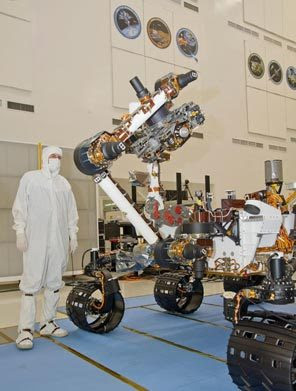
This NASA photo shows the Mars Science Laboratory rover, Curiosity, during testing June 3 at the Jet Propulsion Laboratory in Pasadena, Calif.

One of the most sophisticated space vehicles ever made inches along the rocky landscape, aluminum wheels grinding like a spoon in a garbage disposal.

Here in the Mars Yard at the Jet Propulsion Laboratory, what passes for the Red Planet looks like a vacant lot in Hesperia. The vehicle being tested, a replica of the latest Mars rover that will soon be crawling around up there, looks like a giant mechanical insect — six wheeled legs, an articulating arm and a pair of blue camera lenses like eyes peering from a boxy head.

On Friday, NASA's most ambitious Mars rover mission to date is scheduled to lift off from Cape Canaveral, Fla., aboard an Atlas V rocket. It's a $2.5 billion gamble scientists hope will give unparalleled insights into how Mars evolved and whether it ever could have supported life.T

The Mars Science Laboratory — nicknamed Curiosity — was developed at JPL in La Canada Flintridge, Calif., and will be the fourth rover to traverse the planet's harsh terrain. But unlike the earlier Mars rovers — Sojourner, Spirit and the still-cruising Opportunity — Curiosity will do more than look for evidence of water.

Curiosity is a robot astrobiologist. During a mission expected to last at least two years, the rover will use a battery of scientific instruments to analyze Mars' geology and atmosphere, looking for the elements and chemical compounds that are the building blocks of life.

Scientists hope the information Curiosity gathers will exponentially increase their understanding of Mars and bring us closer to answering the most profound and tantalizing of questions: Could life exist beyond Earth?

"Humans are hard-wired to want to know the answer to that," said Bill Nye, executive director of the Planetary Society, the Pasadena, Calif.-based nonprofit that advocates for space exploration. "If we found life on Mars, it would change everybody's view of our place in space."

Curiosity will take 8.5 months to travel the 354 million miles to Mars — and two years to cover about 14 miles of its surface.

The rover is expected to land Aug. 5 near the Martian equator inside Gale crater, a chasm about the combined size of Connecticut and Rhode Island, with a three-mile-high mountain of layered sedimentary rock at its bottom.

Scientists believe the crater, thought to date back billions of years to when Mars was warm and wet, will reveal the planet's evolutionary story the way the Grand Canyon's strata expose the history of Earth.

"It's going to be like reading a novel — and it's a long one," said John Grotzinger, the project's chief scientist. "It's going to be a wild journey looking into the guts of the history of Mars."

If Curiosity were a car, it would be advertised as fully loaded: six aluminum wheels that can be steered independently. A mounted laser to vaporize rock. Seventeen cameras, to take high-definition images, make scientific measurements and navigate the rover. A robotic arm to drill into rock and scoop up samples. Instruments to detect in those samples organic compounds and elements associated with life on Earth.

And under the hood: a nuclear-powered engine that will give Curiosity a top crawling speed of 2 inches per second.

A big load to land

All that hardware gives the rover a curb weight of a ton. That's five times heavier than its predecessor, which bounced along the Martian surface nestled inside huge protective air bags before coming to rest, like a beach ball tossed from a low-flying airplane.

"The air bags needed to land Curiosity would have been two or three times the weight of the rover itself," said Adam Steltzner, a JPL engineer in charge of ensuring the rover lands in one piece. "There's no landing rocket that could have handled that weight."

So Steltzner's team has engineered an innovative, multi-staged system that, unlike the beach-ball approach, will use sensors and advanced computer software to guide Curiosity's descent to a relatively pinpoint landing.

As planned, the craft carrying the rover will hit Mars' atmosphere at 13,000 mph. Thruster rockets will slow and steer the craft, positioning it for landing. At about 1,000 mph, a parachute will deploy and slam on the brakes. Finally, a "sky crane" will emerge from the craft's descent stage and gently lower a tethered Curiosity to the ground.

All this in just six minutes.

"It looks kind of crazy. And it's definitely novel," Steltzner said. "But we believe it to be a very simple process." The Curiosity rover is one of most complex projects in NASA's history. It's also $900 million over budget and two years late.

An audit released earlier this year by NASA's inspector general criticized managers for repeatedly underestimating the cost of working around the project's numerous technological hurdles — a common complaint of the agency through the years.

All this comes at a time of budget cutting at NASA and a lack of consensus among scientists and politicians as to where the U.S. space program ought to devote dwindling dollars.

"If this fails, it's going to be a disaster," said Nye of the Planetary Society. "Congress will become ever less trusting of the true costs of these missions and the ability of the people doing it."

But Nye says the 26-month delay has a huge upside: It reduced the risk of failure.
"Everyone involved is working very hard to make sure that this succeeds," he said.

The sky-crane landing system is key to a more ambitious future mission: a planned partnership with the European Space Agency to send a rover to collect rock and soil on Mars and cache the samples for an eventual return to Earth.

"There's no such thing as a perfect landing system on Mars," said Steve Squyres, lead scientist for the Spirit and Opportunity rovers. "It's a highly unpredictable environment. It's always possible that a gust of wind or a pointy rock could ruin your day."

Over the last 50 years, more orbiters, probes and rovers have been flung at Mars than any other corner of the cosmos except our moon.

Getting there hasn't been easy. About half of the dozens of spacecraft sent to Mars have either malfunctioned, crashed or disappeared.

Because it's the only planet in our solar system that could have sponsored life — the rest are too hot, too cold or made of gas — public expectations of early trips to Mars were so high that the results seemed disappointing even when the missions succeeded.

In the years since, Mars missions have methodically built a scientifically rigorous portrait of the planet that offer insights on Earth's early history and future.

With this in mind, JPL scientists are downplaying the likelihood that Curiosity might actually find organic matter — a key ingredient for life. Finding conditions that would signal that Mars once could have supported life would be breathtaking in itself.

"You can't promise more than you can deliver. That's what happened" before, said Grotzinger, the mission's chief scientist, a geologist new to the space game.

As wet sediment hardens to rock, organic material is destroyed. Finding even a shred of the stuff in early Earth rocks is extremely rare, Grotzinger said.

"This is like looking for a needle in haystack — and the haystack is the size of Mars," he said. "But that doesn't mean we won't try."

Friday, November 11, 2011

"Of the hundreds of places we could have landed, we've chosen the best place to find habitable environmen. Now we'll see if we find one."


If you think that people who believe in the possibility of extraterrestrial life are kooks, you probably haven't talked to a NASA space scientist in a while.

At a news conference on Thursday, Doug McCuistion, director of the Mars program for NASA, said that when the agency's newest Mars rover blasts off for the red planet on Nov. 25, one of its charges will be to discover if the planet contains (or contained) the ingredients of life.

"This mission will bridge the gap scientifically from our understanding of the planet being warmer and wetter than we probably believed, to not seeking life itself, but seeking signs of life," he said.

He reiterated: "This is not a life-seeking mission."

Think about the mission this way: If NASA were going to Mars looking for signs of pancakes instead of signs of life, on this trip it would be looking for flour and eggs, not pancake crumbs -- and definitely not pancakes.

In an interview with The Times, Joy Crisp, deputy project scientist for the Mars Science Laboratory, said the rover will be looking for organic molecules and isotopic signatures that might indicate that life did exist at one time on Mars.

"If this step pans out, if we do find organic compounds and we think that the rocks look likely to preserve evidence of life, then we will know better what to send next," she said. "It is kind of an intermediate step."

Asfor the rover itself -- called Curiosity -- it's 6-feet-tall, weighs roughly 2,000 pounds, and is the most complex machine to be placed on another planet, according to McCuistion.

The rover has high-definition cameras, a laser eye, and a weather station to help scientists monitor the environment. It also has the ability to sample rocks and soils, and a drill that will allow it to capture material from inside rocks.

"This is a Mars scientist dream machine," said Ashwin Vasavada, Mars Science Laboratory deputy project scientist, at the news event.

But the rover won't be landing on the planet for a while. Curiosity is scheduled to leave Earth on Nov. 25 (the day after Thanksgiving), but it won't be landing on Mars until August 2012.

During the news conference, Vasavada was asked how likely he thought it was that Curiosity would find evidence of life on Mars.

"That would be in the realm of speculation," he said, "but the reason we are excited about Mars is that when we look into the distant past, there is evidence of rivers flowing and lakes and we are trying to find out if they are habitable environments."

Friday, September 30, 2011

Martian Life's Last Stand in the Trenches?


Scientists have found water-bearing deposits on Mars that are out of step with what was happening elsewhere on the planet, raising the prospect that the sites could have hosted Martian life's last stand.

The deposits are a type of clay called smectites, which contain a blend of silica with aluminum, iron or magnesium. They form in the presence of water.

The deposits were found in an unlikely locale -- roughly 30 feet up from the ground inside two troughs in Noctis Labyrinthus ("the labyrinth of the night"), a maze-like system of deep valleys located near the western end of the massive Valles Marineris canyon that cuts across the face of Mars.

Tuesday, September 20, 2011

19 September 1955: Plant Life on Mars?


Originally published in the Manchester Guardian on 19 September 1955

The sudden appearance of a large dark spot on the surface of the planet Mars was announced yesterday by the National Geographic Society in Washington. It was also claimed that this discovery supported the conclusion "that Mars is not a dead world, that the darkening is due to the growth of plant life." The observation has been made by Dr E. C. Slipher, the director of the Lowell Observatory, in South Africa.

Dr Slipher has spent a large part of his long life (he is nearly 80) photographing the surface of Mars.

This event is certainly remarkable, but it is unlikely that scientists will accept the suggestion that the appearance of this spot is evidence of vegetable life on the planet. Professor Znedik Kopal of Manchester University said last night that the claim "must be taken with a pinch of salt." The difficulty is that there are at least two ways of accounting for the appearance of dark spots on the surface of the planet and simple photography of them cannot decide between the two theories.

It is, however, clear that the dark spots must be produced by some active mechanism. Most of the surface of the planet is covered with a thick layer of sandy dust (it is a desert), and it is known that winds with speeds of several miles a second blow in the thin Martian atmosphere. Any dark material on the surface would rapidly become covered with a thin layer of obscuring dust if there were not some way in which it was regenerated.

The assumption that the dark patches are areas of vegetation has been common, for several decades. The difficulty is to see how any vegetation could grow in the planet's strange atmosphere.

The most favoured of the alternative theories is that the dark spots are caused by volcanic activity. Each black area would be brought about by pumice dust from an active volcano falling on the sandy desert and concealing it from view. This supposes that the volcanoes remain active for a considerable length of time, but there is no direct way of proving or disproving this.

To distinguish between these theories experiments are now being carried out in several laboratories throughout the world. In the end the question will be decided by the colour of the light which the spots reflect. When accurate measurements of the proportions of red, blue, and yellow light from the spots are available, these will be compared with laboratory measurements of the light reflected from pumice, lava, and vegetation. The prize will go to that material which best simulates the behaviour of the spots.

© 2011 Guardian News and Media Limited or its affiliated companies. All rights reserved.

WHO WAS Dr. E.C. Slipher?

Earl Carl Slipher was born on a farm near Mulberry, Indiana on March 25, 1883. He began his higher education at Indiana University, where he received his B.A. degree in 1906 and his M.A. degree in 1908. He earned this M.A. through the Laurence Fellowship, which allowed him to work toward his master's degree at Lowell Observatory from 1906 to 1908. He received honorary LL.D degrees from the University of Arizona and Northern Arizona University in 1960.
Slipher began his lifelong career as a planetary astronomer in 1907 when he observed Mars during an expedition to the Andes led by David Todd and supported by Percival Lowell. He became an astronomer at Lowell Observatory in 1908. At this institution, he became one of the first people to use multiple image printing, in which several images taken in close succession are superimposed onto one photographic plate in order to improve the information content in any given picture. In 1918, he became one of the first people to standardize his photographic plates for photometric measures, a procedure which is now universally used.
In 1939, 1954 and 1956, Slipher led expeditions to the Lamont-Hussey Observatory at Blemfontein, South Africa in order to observe Mars while it was in opposition. He was also instrumental in organizing the International Mars Committee (1954), which was designed to coordinate observatories around the world in order to observe Mars continuously for several months before and after an opposition. In 1960, Slipher headed an United States Air Force project designed to update the techniques used to observe Mars. Slipher was also the acting director of Lowell Observatory from January 3rd, 1957 until September 1958.
Slipher did not, however, limit his activities to the confines of Lowell Observatory. He was the mayor of Flagstaff (1918-1920), a Flagstaff city council member (1917), a State Legislature member (from which position he resigned in 1933), and a member of the Flagstaff draft board (1940-1945).

E.C. Slipher died in Flagstaff, Arizona on August 7, 1964 at the age of 81

Monday, September 19, 2011

NASA Selects University of Texas at Arlington chemistry professor's technology to determine if there is life on Mars.


This schematic diagram of an ion chromatography run depicts how elution time correlates to output peak data. Diagram courtesy of Madison Area Technical College. Copyright 2006 by the Biotechnology Project at MATC.

The National Aeronautics and Space Administration believes that a University of Texas at Arlington chemistry professor's technology may hold the key for determining whether life could exist on Mars and could even help humans explore the Red Planet someday.

Purnendu "Sandy" Dasgupta has been awarded a $1.2 million grant to develop an ion chromatograph that is durable enough to withstand extraterrestrial extremes and sensitive enough to pick out differences between ions.

"He's developed a new system for testing the chemical composition of the soil on Mars," said Pamela Jansma, dean of UTA's College of Science. "We don't understand much about Martian soil, so for any kind of new technology to be able to adapt to the conditions of the Martian surface is new."

An ion chromatograph separates and detects ions, which are atoms or molecules bearing an electrical charge. The device can identify a broad range of ions.

"By creating an easily portable and robustly designed ion chromatograph, we're hoping to rapidly expand scientists' knowledge of extraterrestrial geology and geochemistry," Dasgupta stated. "With this machine, we should be able to unequivocally answer if organic ions are present."

Finding organic ions in Martian soil could lead to identifying organic compounds, which are necessary for life to exist.

Dasgupta's project was one of eight nationwide to be funded recently by grants from NASA's astrobiology program.

"Every scientist deep down is fascinated with the solar system and curious about whether there's life elsewhere," Jansma said. "This type of research captivates people."

Dasgupta will design and build an open tubular ion chromatograph that weighs no more than 3 kilograms. Researchers and students will test it in Chile's Atacama Desert, one of the most arid, barren places on Earth.

After that, they'll refine the machine for use on Mars.

Dasgupta's collaborators on the project include professors from Texas Tech and Tufts universities and a NASA research scientist.

The four-year time frame is a plus to students: "As it goes from conceptual stages to the prototype to field research, you can really see the process associated with research and development," Jansma said. "Students can really see it from start to finish. How exciting to have something that is intended to go another planet."

"It's enough time to take undergraduate and graduate students, involve them in an innovative project, and then they can use what they're doing for their graduate research," Jansma said. "It's also broad enough and of sufficient interest to so many people."

Some typical applications of ion chromatography include:
•Drinking water analysis for pollution and other constituents
•Determination of water chemistries in aquatic ecosystems
•Determination of sugar and salt content in foods
•Isolation of select proteins


Current research in the Dasgupta group include:

Chip-scale instruments,
Novel detection and data transform schemes in chromatography,
Iodine nutrition of women and infants and the effects of perchlorate thereon,
Development of iodine and Selenium analyzers,
Green analysis of arsenic in drinking water,
Measurement of cyanide in saliva, blood, and breath towards rapid treatment of cyanide poisoning,
Rapid analysis of trace heavy metals in atmospheric aerosol to act as conservative tracers,
Absolute Charge detection in solution and its many ramifications.


The research in the Dasgupta lab is targeted towards finding the best solution to a problem and is not married to any specific technique. Laboratory-built instrumentation are as commonly used as commercial chromatographs, mass spectrometers, etc. and are often preferred.

Students are necessarily trained in electronics and computer-interfacing and writing appropriate instrument control/data acquisition software. We foster builders, not users.