Sunday, August 22, 2010

Martian mud volcanoes may hold the secret to life on Mars


Mud volcanoes are unusual geological structures that blast up sediments from deep underground. Such volcanoes are doubly perfect places to look for life on Mars - they spew out secrets of ancient Mars while providing the perfect environment for life.

Mud volcanoes are structures in which gas, liquid and mud (or, more technically speaking, fine-grained rock) are shot up from miles underground in much the same way regular volcanoes force up magma. The sentiments revealed by these volcanoes come from buried layers that we wouldn't normally be able to see without drilling deep into the red planet's surface. According to NASA scientist Dorothy Oehler, that helps make the mud volcanoes of Mars's Acidalia Planitia the perfect place to look for life:

"If there was life on Mars, it probably developed in a fluid-rich environment. Mud volcanoes themselves are an indicator of a fluid-rich subsurface, and they bring up material from relatively deep parts of the subsurface that we might not have a chance to see otherwise."

Oehler and her research partner Carlton Allen have mapped 18,000 mud volcanoes in this region of Mars, and they estimate another 20,000 or so could be found if mapping continues. They used new images from the Mars Reconnaissance Orbiter along with data from a state-of-the-art imaging spectrometer to first find the volcanoes and then to figure out their mineralogical makeup. These studies showed conclusively that they were indeed mud volcanoes, ruling out the possibilities that they were caused by other processes like meteorite impacts, ice, or evaporation.

We've known about the volcanoes since the Viking probe discovered them in the 1970s, but only recently have astronomers suggested they could be mud volcanoes. One of the first to suggest this possibility was Kenneth Tanaka of the U.S. Geological Survey:

"I also thought that these features, which also occur elsewhere in the northern plains of Mars, were good places to search for signs of life. If life were present in the subsurface, the water and slurries involved in forming the mud volcanoes would have brought it to the surface. While life may not have survived at the surface, it at least could have been brought there by this process."

The Martian surface is probably too tough an environment for life to survive up there, but it's possible microbes still survive deep down below. The sediments ejected by these volcanoes would give today's probes and robotic rovers - and, by extension, the scientists back on Earth - an opportunity to test the Martian underground for signs of organic life. It's our best chance to study deeply buried layers until we can build a drill on Mars, something that is probably decades away.

Still, there's still room for skepticism. As Tanaka points out, we may be getting to the mud volcanoes too late to learn the secrets they might have held:

"There has been a great amount of time [for UV radiation and other surface processes] to destroy possible microfossils in surface rocks and soils. For this reason, it is unclear if these features are the best places to search for preserved life. Better places might include recent crater impacts and deposits from younger flood discharges."

And yet, Oehler remains optimistic. It all comes down to that perfect combination of the right location for life to emerge and the right mechanism to bring the evidence up to the surface:

"We do believe that Acidalia is a place where life could have been abundant because of long-lived water sources. It is one of the better places to look for evidence of life - if life ever developed on Mars."

[Icarus via Astrobio]

Send an email to Alasdair Wilkins, the author of this post, at alasdair@io9.com.

Monday, June 21, 2010


The country that invented the Walkman may be back on track to burnish its image as a technological pioneer. Right now, more than 4.7 million miles from Earth, is a revolutionary spacecraft that could be the future of interstellar travel. Japan's space program, JAXA, confirmed on June 10 they had successfully unfurled the world's first solar sail — a spacecraft that uses the velocity of sunlight to propel it. Then, just three days later, Japan announced what could be an even more impressive accomplishment: a spacecraft that left Earth seven years ago had returned home. Before brilliantly burning up over Australia, the ship ejected a soccer-ball-sized pod — a modest container that may contain the first fragments of an asteroid ever brought to earth and provide clues about the origins of our planet. Not bad for a spacecraft running three years behind schedule and without three of its four engines.

These space exploits couldn't have come at a better time for Japan's space agency. With a stagnant economy and massive public debt, the new Prime Minister Naoto Kan has promised to make cuts to Japan's sprawling bureaucracy, and JAXA will surely come under scrutiny. During the previous administration, the Wall Street Journal reported that the government revitalization unit recommended in April the space agency start raising more money from the private sector. Before that, JAXA requested almost $19 million to develop a follow-up asteroid project, but the Hatoyama administration only allocated a meager $330,000. These were not encouraging signs for the future of the agency, and this from the Prime Minister whose wife once claimed aliens took her soul to Venus in a triangular spacecraft.

The solar sail may look low-tech, resembling a silver tarpaulin with a hole in the middle, but its successful mission could help future trips to the outer reaches of our solar system. JAXA's Interplanetary Kite-Craft Accelerated by Radiation of the Sun, better known as IKAROS, will be the first spaceship powered without any rocket fuel. Unlike its mythological namesake, in which the Greek god Icarus flew too close to the sun and melted his wings, Japan's IKAROS will use the force of the sun's photons against its sail to propel it closer and closer to the sun. IKAROS' first stop is Venus, and then hopefully the unmanned spacecraft will push past the planet to the far side of the sun. Ships like IKAROS powered by solar sails may not be the fastest spacecrafts, but they're much cheaper than rocket-fuelled ones. Makoto Miwada, a JAXA spokesman, says the IKAROS test will be half the price of a typical large satellite launch. "This satellite is rather cheap," he says.

If all this sounds like science fiction that's probably because until recently it was. Solar sails have been featured in science fiction since the early 1960s and even made an appearance in James Cameron's Avatar. The goal of the IKAROS project is to test the feasibility of using sunlight to maneuver a spaceship, and a lot could still go wrong. With the sail's membrane as thin as 0.0075 mm — less than one-sixth of the thickness of a newspaper page — it's extremely fragile, and nothing like this has been done before. Already though, the Japanese succeeded in unfurling the sail in space, something that American groups have failed at doing in two previous attempts, according to the Sydney Morning Herald. In this case, JAXA weighted the corners of the sail. The slow spin of the spacecraft caused centrifugal force to open the sail to full extension.

Japan's second space feat last week points more toward the past than the future, back some 4.6 billion years to the formation of our solar system. JAXA launched the Hayabusa in 2003. The space probe took more than two years to reach its target, the Itokawa asteroid, considered a "near-Earth" asteroid. It was only about 185 million miles away when the Hayabusa arrived. Since then things haven't exactly gone smoothly. There was a fuel leak, a tool for collecting rock samples that failed to deploy and a 50-day communications blackout, and by the end of the mission three of craft's four ion engines had broken. It even missed its initial window home and had to return to Earth three years late. With all the delays, the Hayabusa broke the record for the longest voyage in space.

Despite the glitches along the way, the Hayabusa project is already a landmark mission. The Hayabusa's journey was the first ever round-trip to a celestial body other than the moon. The craft has determined Itokawa's size, shape, density and approximate makeup. Still, the real boon was bringing the first asteroid samples home, where more detailed analysis could take place. The Hayabusa disintegrated as it re-entered the earth's atmosphere on June 13, creating a brilliant display over central Australia — "like fireworks" says JAXA's Miwada. But a few hours before burning up, it successfully ejected a small pod that likely contains the first asteroid fragments brought back to Earth. The capsule was located in the Australian outback and returned to Japan on June 17, still apparently sealed. Miwada says it could take months to know exactly what's in there; after seven years of waiting, no one wants to risk contamination. It will be disassembled in a special isolation system so it's not exposed to the atmosphere. Says Miwada: "We may find many particles, and we have to analyze every one and judge whether it's an earth particle or a space particle."

Scientists at both NASA and JAXA say it's likely the Hayabusa has returned at least some asteroid material, and scientists don't need much to determine its exact composition. Asteroids are among the least changed objects in the solar system, and understanding what they're made of can give scientists clues to the origins of our planet. "We'll be looking at leftover debris from the early solar-system formation process," says Donald Yeomans, a manager at NASA's Near-Earth Object Program Office. "[Asteroids] offer an excellent window into the chemical mix and temperature environment at the time the planets formed."

Miwada says locating the capsule in the Australian bush was a "special moment" for the JAXA team. And it's not just the scientists who are proud. In Japan, the public has started to refer to the Hayabusa as Hayabusakun, adding an affectionate suffix to the spacecraft normally reserved for boys or young men. At a JAXA office in Tokyo, according to the daily Yomiuri Shimbun, one visitor wrote, "I'm very happy — I feel like my son has come back home." With a moribund economy and another new Prime Minister, the JAXA accomplishments over the past 10 days have given a country a reason to look away from its earthly problems and get satisfaction from the heavens. As another visitor to the JAXA office wrote, "Sick of gloomy days caused by the recession, Hayabusa's story has made me really happy. From tomorrow I'll be able to work more cheerfully." It's no wonder, then, that Prime Minister Kan said last week he's considering raising the budget for Hayabusa II.


Read more: http://www.time.com/time/world/article/0,8599,1997768,00.html#ixzz0rWGbar4N

Saturday, June 5, 2010


Titan: Nasa scientists discover evidence 'that alien life exists on Saturn's moon'
Evidence that life exists on Titan, one of Saturn’s biggest moons, appears to have been uncovered by Nasa scientists.

By Andrew Hough
Published: 8:30AM BST 05 Jun 2010
http://www.telegraph.co.uk/science/space/7805069/Titan-Nasa-scientists-discover-evidence-that-alien-life-exists-on-Saturns-moon.html

Artist's impression of a mirror-smooth lake on the surface of Saturn's smoggy moon Titan. Photo: NASA Researchers at the space agency believe they have discovered vital clues that appeared to indicate that primitive aliens could be living on the planet.

Data from Nasa's Cassini probe has analysed the complex chemistry on the surface of Titan, which experts say is the only moon around the planet to have a dense atmosphere.


Related Articles
Science predictions for 2009
Aliens in UFOs have visited Earth, says David Cameron
Pic du Midi, Pyrenees: Mission to a frozen fortress
Thousands of hidden artworks could be uncovered by new x-ray technique
Give scientists the freedom to be wrong
Building block of life found in comet trailThey have discovered that life forms have been breathing in the planet’s atmosphere and also feeding on its surface’s fuel.

Astronomers claim the moon is generally too cold to support even liquid water on its surface.

The research has been detailed in two separate studies.

The first paper, in the journal Icarus, shows that hydrogen gas flowing throughout the planet’s atmosphere disappeared at the surface. This suggested that alien forms could in fact breathe.

The second paper, in the Journal of Geophysical Research, concluded that there was lack of the chemical on the surface.

Scientists were then led to believe it had been possibly consumed by life.

Researchers had expected sunlight interacting with chemicals in the atmosphere to produce acetylene gas. But the Cassini probe did not detect any such gas.

Chris McKay, an astrobiologist at Nasa Ames Research Centre, at Moffett Field, California who led the research, said: “We suggested hydrogen consumption because it's the obvious gas for life to consume on Titan, similar to the way we consume oxygen on Earth.

"If these signs do turn out to be a sign of life, it would be doubly exciting because it would represent a second form of life independent from water-based life on Earth.”

Professor John Zarnecki, of the Open University, added: “We believe the chemistry is there for life to form. It just needs heat and warmth to kick-start the process.

“In four billion years’ time, when the Sun swells into a red giant, it could be paradise on Titan.”

They warned, however, that there could be other explanations for the findings.

But taken together, they two indicate two important conditions necessary for methane-based life to exist.

Thursday, June 3, 2010


http://news.bbc.co.uk/2/hi/science_and_environment/10197470.stm

Six would-be cosmonauts have entered a sealed facility where they will spend 18 months with no windows and only e-mail contact with the outside world.

The men are taking part in the Mars500 project, which aims to simulate a mission to Mars.

They entered the craft, located at a medical institute in Moscow, just before 1100 BST on Thursday.

Scientists say the study will help them understand how humans would cope on a long journey to another world.

During a press conference on Thursday morning, the six men - three Russians, two Europeans and a Chinese man - all described what motivated them to take part in the experiment.

Twenty-six year old Wang Yue from China, the youngest of the volunteers, said he was excited to be involved in a project that he felt would be "excellent for science and for all of humankind".

French volunteer Romain Charles acknowledged that it would be a "difficult" mission and said that he would miss his family and "the Sun and fresh air".

Space on Earth
The project has been designed to be as realistic as possible even though some elements - such as the weightless conditions of spaceflight - cannot be recreated here on Earth.

"They will have to cope with limited consumables, for example," said Dr Martin Zell from the European Space Agency, a key partner in the project.

Continue reading the main story
When the very first human steps on Mars, I will be able to say, 'yeah, I helped do that'
Diego Urbina

European Mars500 participant
"That means everything will be onboard at the start. There will be no re-load, re-supply whatsoever. It will be like a real mission."

The craft is based at Moscow's Institute of Biomedical Problems and comprises a series of interconnected steel canisters. The total interior volume is about 550 cubic metres.

Four of the tubes provide the living and working environment on the "journey" to and from Mars. Their interior has been decorated with wood panelling to give the cylinders a more homely feel.

A fifth module is a mock-up of the Red Planet itself, an enclosed room with a floor covered in rocks and sand.

THE LAYOUT OF THE MARS500 'SPACESHIP'

MEDICAL MODULE: The 12m-long cylinder acts as the laboratory. Should a crewmember become ill, he can be isolated and treated here

HABITABLE MODULE: The main living quarters. The 20m-long module has beds, a galley, a social area. It also acts as the main control room

LANDING MODULE: This will only be used during the 30-day landing operation. There is room only for the three crewmembers who will visit the "surface"

STORAGE MODULE: The 24m-long module is divided into four compartments, to store food and other supplies, to house a greenhouse, a gym a refrigeration unit

SURFACE MODULE: To walk across the soil and rocks of Mars, crewmembers must put on Orlan spacesuits and pass through an airlock


About half-way through the mission, three of the crew will have to "land" on this "surface" and walk about on it while dressed in heavy space suits.

The "cosmonauts" will be commanded by 38-year-old marine engineer and astronaut trainer Alexey Sitev, who has only recently been married.

His compatriots - Sukhrob Kamolov (32) and Alexander Smoleevskiy (33) - have medical backgrounds. The two Europeans in the group - Diego Urbina (27) and Romain Charles (31) - are engineers by training. Wang Yue has a "day job" training Chinese astronauts.

Near a hundred experiments will be performed during the "journey" Colombian-Italian Diego Urbina said his motivation came from his desire to work in space research.

"I'm also very interested in being a part of the story of getting humans to Mars," he told BBC News. "When the very first human steps on Mars, I will be able to say, 'yeah, I helped do that'. That will make me feel very proud."

Scientific investigations during the experiment will assess the effect that isolation has on various psychological and physiological aspects such as stress, hormone levels, sleep quality, mood and the benefits of dietary supplements.

Dr Berna van Baarsen, from the Free University Medical Center, Amsterdam, Holland, is a principal investigator on Mars500.

"We expect Mars500 to have Earth applications, in understanding group dynamics connected to isolation and loneliness, for example," she said.

"I hope it will also help us understand better some groups, such as those elderly people who are isolated in their homes. It should tell us about coping behaviours."

The experiment even simulates surface operations at the Red Planet The spaceship itself will come under scrutiny, also, as the crew monitor their surroundings to see which types of bacteria take hold and thrive in the enclosed space.

All of the results of these investigations will have to be emailed to "mission control" as the organisers of the project intend to introduce a 20-minute, one-way time-delay in communications to mirror the real lag in sending messages over the vast distance between Mars and Earth.

"Everything will be done in a telemedicine environment, where the crew has to do the analysis and we receive the data by telemetry," said Dr Zell, who heads up Europe's space station utilisation programme.

This 520-day mock mission with its 30 days of "surface operations" is the final phase of the three-part Mars500 project.

Look around the spacecraft that will be the crew's home for almost 18 months
There have already been two smaller studies, one lasting 14 days and another taking 105 days to complete.

Space agencies describe Mars as the "ultimate destination" for human explorers. However, they do not possess the technology to complete such an endeavour and are unlikely have it for many years yet.

Jonathan.Amos-INTERNET@bbc.co.uk

Saturday, March 6, 2010


--------------------------------------------------------------------------------

Could the Tumbleweed Rover Dominate Mars?
By Ian O'Neill Thu Mar 4, 2010 08:22 PM ET
http://news.discovery.com/space/could-the-tumbleweed-rover-dominate-mars.html?print=true
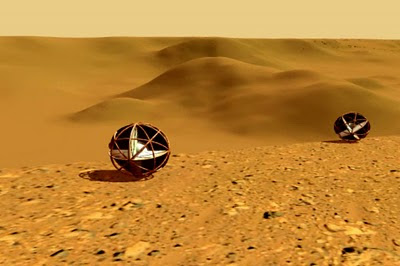
Tumbleweed probes exploring the Dao Vallis region of Mars. The inhospitable terrain is un-passable using conventional rovers, whereas a wind-blown Tumbleweed could traverse the gullies and debris to look for water and life (NASA LaRC/Case Western University/NASA Planetary Data System)

Before Mars can become the next great frontier for human exploration, we need to send more robotic missions to gather as much information as possible about our planetary neighbor. But what kind of robot has the right combination of weight, cost and range, while still being able to carry out groundbreaking science?

Cue the Tumbleweed Mars rover, an ingenious concept vying for attention in the hope of becoming an entirely different method to explore vast regions of the Martian surface, one that rolls across the surface instead of six-wheeling.

Orbiters, Landers, Rovers and... Tumbleweeds?

The robotic exploration of Mars has come in three shapes so far. First and foremost are the orbiters; satellites inserted in various Martian orbits, viewing the planetary surface with ever increasing resolution from hundreds of miles in altitude. Although they can't do science in situ, they can gain a global perspective on the Martian geography.

Then there are the landers; stationary probes carrying a suite of instruments to dig and analyze the local Martian dirt. They might be stuck on the spot, but they can do a lot of science.


A comparison of dust cover on NASA's Mars Expedition Rover Spirit's solar panels (NASA/JPL).And then there's the rover; a balance between mobility and scientific payload. Although there have only been three successful rover missions to date (two of which are still reporting for duty) and two more are planned for launch in the coming years, this is arguably the best way to trundle across the Martian surface. But even rovers have their limitations.

Complex moving parts (such as wheels and joints) get clogged or jammed, solar panels often get coated in dust and although their range can be impressive for an extraterrestrial robot, they can't really explore vast regions of Mars' surface. Opportunity is doing well, notching up kilometers on the odometer. Although Spirit is still soldiering on, the rover is firmly stuck in a sand trap in Gusev Crater.

(The upcoming Mars Science Laboratory Curiosity bypasses the solar array dust problem by using a radioisotope thermoelectric generator -- or RTG for short -- to power it. This car-sized rover will be able to dominate the Martian surface day, night and during the worst dust storms.)


A Short History of the Tumbleweed

So, before humans can explore where only robots have dared to tread, we need more reconnaissance missions with the ability to explore greater areas of the Martian landscape. This would be hugely beneficial for the continuing search for Martian life, as so far we've been restricted to only exploring tiny patches of Mars.

The robotic Tumbleweed could be the mission to fulfill these aims.

The idea of sending a spherical, wind-propelled vehicle (or "Mars Ball") to the Red Planet was originally conceived in 1977 by Jacques Blamont of NASA's Jet Propulsion Laboratory (JPL) and the University of Paris. This was shortly after the Mars Viking Landers discovered that the Martian atmosphere consisted mainly of carbon dioxide and had relatively strong winds. However, the modern incarnation of the Tumbleweed was inspired by accident.


The inflatable Mars Tumbleweed concept during tests in Antarctica in 2004 (Alberto Behar/NASA JPL)In 2000, another JPL team headed by Jack Jones was testing a three-wheeled inflatable rover in the Mojave Desert, Calif., when one of the "wheels" broke off and was blown over the sand dunes.

This inflatable ball bounced over boulders, sped up steep slopes and traveled over coarse vegetation with ease. As Jones' team chased after the oversized beach ball (measuring 1.5 meters in diameter), the idea was born: An independent ball that acts like a tumbleweed could have the potential to explore Mars, propelled only by the Martian winds.

HowStuffWorks: The Mars Tumbleweed gained its inspiration from its natural terrestrial counterpart, but how do tumbleweeds work?


To Rove or Roll?

But could this fascinating concept supersede the Mars rover as planetary exploration vehicle of choice? Let's face it, NASA's Mars Exploration Rovers have outlived their planned mission lifetimes by six years (they were designed to last five months). Why would we want to deviate from such a successful means of exploring this alien landscape?

"Spirit and Opportunity have been nothing short of spectacular. However, they have very limited mobility, which is often dictated by the terrain," Dr. Kim Kuhlman, Senior Research Scientist of the Planetary Science Institute, told Discovery News.

Kuhlman is one of the Tumbleweed scientists heading this effort to communicate the science behind this unique vehicle. She is scheduled to present the Mars Tumbleweed proposal at the Earth and Space 2010 conference in Hawaii on March 16.

"A fleet of Tumbleweeds could cover a much greater area using the wind for propulsion," she added. "Some of them may get stuck and become stationary platforms similar to Spirit's current situation, but the majority would perform a 'random-walk' survey of an area orders of magnitude greater than that of a rover."


The inflatable Tumbleweed concept being propelled by the Mars wind (NASA LaRC/Case Western University/NASA Planetary Data System) [Watch the video]But before this plan can advance beyond the concept phase, more funding is needed to develop the miniaturized instrumentation that would need to be carried aboard the Tumbleweeds. If researchers can get the funds, the physical size of scientific experiments could be shrunk, making them easier for the spherical probes to tote.

The Tumbleweeds are intended to track atmospheric conditions, geographical location, communicate with orbiters (to relay data back to Earth), and even probe the chemistry of Martian soil, so the smaller the better. They could even generate their own power by harnessing the kinetic energy their motion generates.

There's also the tantalizing possibility that a fleet of Tumbleweeds -- each with different instruments on board -- could "swarm" and act as one unit to carry out a sophisticated array of measurements.

"The instrumentation is constantly being miniaturized and some components could actually come off the shelf. The real constraining factor as to how many and which instruments are deployed is the amount of power that can be incorporated. Batteries add mass, which slows down the Tumbleweed. One can certainly envision a fleet of Tumbleweeds that have various configurations of instruments and the capability to swarm if one Tumbleweed finds something of great interest. This would, of course, require a means of controlling the direction of movement of the Tumbleweeds. This technology is not very mature because funding has not been available." -- Kim Kuhlman.

They Come in All Shapes and Sizes

If the project is given the go-ahead, NASA will need to decide what configuration of Tumbleweed would be most efficient and/or practical.

For example, the inflatable Tumbleweed concept is a tried and tested vehicle, having undergone extensive field tests in Greenland and Antarctica in 2003 and 2004. The inflatable Tumbleweed traversed hundreds of miles while continually relaying atmospheric measurements and location data.


Miniature sensor platforms could be dropped by the Tumbleweed to further investigate a location of special interest while the Tumbleweed continues on its way (NASA LaRC/Case Western University/NASA Planetary Data System)
[Watch the video]It is also hoped the inflatable design could be commanded to deflate at locations of interest, causing it to "sit down" and stop rolling. As the underside will be in greater contact with the ground, perhaps analysis tools can be lowered into the cavity beneath, sampling any gases vented from the ground. (Watch the video to see the inflatable Tumbleweed in action.)

Another prominent Tumbleweed design is a ridged "box kite" type. Although this technique is less mature than the inflatable design, the sail-like paddles have a better drag coefficient. This means they will use the available Mars winds more efficiently, perhaps traveling further and faster.

To aid control over the Tumbleweed, an offset weight housed in the center of the sphere could be commanded to alter position, shifting the Tumbleweed's center of mass and essentially steering it that way.

These concepts, along with others -- namely the Dandelion, Eggbeater, and Tumble-cup configurations -- have been tested and developed by a collaboration of research institutions including NASA Langley Research Center, North Carolina State University, Texas Tech University, the Biorobotics Laboratory at Case Western Reserve University and Planetary Science Institute.


Ready to Roll?

Although we probably won't see a fleet of Tumbleweeds bouncing across the Martian surface any time soon, it is certainly a novel approach to planetary exploration. However, Kuhlman will have her work cut out to convince the world that this paradigm shift in robotic exploration is a viable one.

"I've actually had a very influential scientist in astrobiology call the idea "loopy" to my face," she added.

But critics be warned, the Tumbleweed scientists have been working on this project for a decade and Kuhlman is lead author of a chapter titled "Tumbleweed: A New Paradigm for Surveying the Surface of Mars for In-situ Resources" of the book Mars: Prospective Energy and Material Resources.

Thursday, February 25, 2010

FOX News:

At a press conference Wednesday, Silicon Valley startup Bloom Energy showed off its new, heavily hyped technology, which harnesses chemical reactions to create energy. The company’s mission: to revolutionize the world’s fuel sources.

Bloom’s main product is the Bloom Energy Server, a generator based around a smart new fuel cell technology. Fuel cells rely upon chemical reactions to generate energy rather than fossil fuels, and as such are considered cleaner, more affordable, and more reliable than the traditional energy sources.

Fuel cell technology has been under development for decades, primarily concentrating on chemical reactions using hydrogen — an element that can be volatile and difficult to store. Bloom’s fuel cell technology is fundamentally different, running on a wide range of renewable or traditional fuels.

The technology has roots in NASA’s Mars space program, where Dr. KR Sridhar, principal co-founder and CEO of Bloom Energy, was charged with building technology to help sustain life on Mars. His mandate: Use solar energy and water to produce air to breath and fuel for transportation.

Sridhar’s invention converts air and nearly any fuel source — ranging from natural gas to a wide range of biogases — into electricity via a clean electrochemical process, rather than dirty combustion.


Even running on a fossil fuel, the systems are approximately 67% cleaner than a typical coal-fired power plant, explains Bloom. When powered by a renewable fuel, the company’s Energy Server can be 100% cleaner. Each Energy Server consists of thousands of Bloom’s fuel cells, flat, solid ceramic squares made from a common sand-like “powder.”

Bloom Energy states that to date, Bloom Energy Servers, currently in deployment for several Fortune 500 companies, have produced more than 11 million kilowatt hours (kWh) of electricity, with CO2 reductions estimated at 14 million pounds.

The technology industry breathlessly watched and waited for Wednesday’s unveiling. John Doerr, a partner at investment firm Kleiner Perkins Caufield & Byers and Bloom Energy board member, shared in the hype.

“For years, there have been promises of new energy solutions that are clean, distributed, affordable, and reliable; today we learn that Bloom, formerly in stealth, has actually delivered,” he said. “Americans want clean, affordable, energy, 24×7 — and all the jobs that go with it. Bloom’s boxes are a breakthrough, serving energy, serving demanding customers, and serving our country.”

The company’s customers seem to echo Doerr’s enthusiasm, many of which are leading businesses. Coca-Cola, Cox, eBay, FedEx, Google, Staples, and more have been running the Energy Servers.

Coke’s 500kW installation at its Odwalla plant in Dinuba, CA, will run on re-directed biogas and is expected to provide 30% of the plant’s power needs while reducing its carbon footprint by an estimated 35%.

“This new fuel cell technology has great promise and represents an important step for Coca-Cola in continuing to grow our business without growing the carbon footprint,” said Brian Kelley, President and General Manager, Coca-Cola North America. He noted that the Bloom Servers can help the company reduce carbon emissions while improving efficiency and using cleaner forms of energy.”

In a video shown at the event, California Senator Dianne Feinstein, Cypress Semiconductor CEO T.J. Rogers, New York Mayor Michael Bloomberg and others raved about the new innovation.

Mayor Bloomberg said he was excited from the first time he saw the technology in action: “My first reaction was this was a company guaranteed for greatness.”

“When we look at Bloom Energy,” he added, “we are looking at the future of business, at the future of the economy, at the future of America.”

Thursday, February 18, 2010

Humans are no strangers to ravaging the land, but the stars have proven a good deal more elusive. So far, our ethical concerns have remained limited to the contamination of extraterrestrial environments, but what will the future bring?

Last night I attended a lecture by Jesuit Brother Guy J. Consolmagno, a U.S. research astronomer and planetary scientist at the Vatican Observatory. He gave a very engaging talk about the ethics of exploration and planetary astronomy, touching on two particularly noteworthy items:

Asteroid Mining
Can you put a price tag on an asteroid? Sure you can. We know of roughly 750 S-class asteroids with a diameter of at least 1 kilometer. Many of these pass as near to the Earth as our own moon -- close enough to reach via spacecraft. As a typical asteroid is 10 percent metal, Brother Consolmango estimates that such an asteroid would contain 1 billion metric tons of iron. That's as much as we mine out of the globe every year, a supply worth trillions and trillions of dollars. Subtract the tens of billions it would cost to exploit such a rock, and you still have a serious profit on your hands.

But is this ethical? Brother Consolmango asked us to ponder whether such an asteroid harvest would drastically disrupt the economies of resource-exporting nations. What would happen to most of Africa? What would it do to the cost of iron ore? And what about refining and manufacturing? If we spend the money to harvest iron in space, why not outsource the other related processes as well? Imagine a future in which solar-powered robots toil in lunar or orbital factories.

"On the one hand, it's great," Brother Consolmango said. "You've now taken all of this dirty industry off the surface of the Earth. On the other hand, you've put a whole lot of people out of work. If you've got a robot doing the mining, why not another robot doing the manufacturing? And now you've just put all of China out of work. What are the ethical implications of this kind of major shift?"

Brother Consolmango also stressed that we have the technology to begin such a shift today; we'd just need the economic and political will to do it. Will our priorities change as Earth-bound resources become more and more scarce?

Terraforming
Most of our planetary colonization dreams revolve around changing the environments of other worlds to cater to our own astronomically particular needs. Seriously, imagine if the Smoking Gun posted humanity's tour rider for visiting other worlds. What utter divas we are! As the alternative of changing ourselves to inhabit other worlds is largely unexplored, we have to ponder the far-future ethics of terraforming another planet.

Specifically, Brother Consolmango mentioned the idea of taking material from a c-class asteroid or a Martian moon and spreading it over Mars' pole caps. In theory, this feat would create the sort of drastic global warming we're hoping to avoid on Earth. Coated with dust, the poles would then absorb even more solar radiation than before, causing them to heat up and release carbon dioxide. Atmospheric pressure would increase. The resulting greenhouse effect could possibly raise temperatures to facilitate stabilized liquid water. This could lead to lakes, oxygen and a successful seeding of plant life. Eventually, Arnold Schwarzenegger would be able to take his space helmet off without his eyeballs exploding.

But what are the ethics of this (the terraforming, not the eyeball thing)? What if Mars already contains hidden life? Might the origins of life on Earth trail back to the red planet as well? Thoroughly contaminate everything and we might erase all trace of what was. And the past isn't the only thing potentially at stake.

"Here's a deeper question," Brother Consolmango said. "What if there is no life on Mars or Titan or some other place we're going to go to, but all the ingredients are there, such that at some future time life could exist. The potentiality of life is there and, by terraforming it, we're aborting that possibility. Under what circumstances is that an ethical thing to do?"

What do you think?

In addition to covering these topics, Brother Consolmango also touched base on the issues of light pollution, meteorite collecting and the coexistence of science and religion. On the meteorite issue, I was pleased to hear him hit all the points I made in my recent post on the matter.

And you can read Robert Lamb's HowStuffWorks.com blog post
Can science and religion coexist?
for more on the religion/science issue.

Either way, feel free to spill your thoughts on the ethics of planetary exploration
and colonization.
Learn to exploit some space at HowStuffWorks.com:
How Asteroid Mining Will Work
How Iron and Steel Work
How Mars Works
How Terraforming Mars Will Work
How Light Pollution Works